

 Apple Podcasts
 Spotify
  RSS Feed
 Allison Komiyama, CEO and Founder at Bluestocking Health, LLC
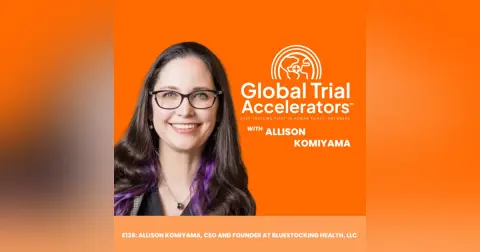
In this episode, we are joined by Allison Komiyama, Founder of Bluestocking Health, for a conversation about medical devices, regulatory strategy, clinical evidence, and the journey of bringing innovative medical technologies to market.
Allison has spent most of her career helping medical device companies navigate the regulatory process and successfully bring their technologies to market. Over the past seventeen years, she has been involved in hundreds of FDA pre-submissions and premarket submissions covering a wide range of medical device technologies.
Her career includes serving as an FDA reviewer in the Center for Devices and Radiological Health (CDRH), as well as founding AcKnowledge Regulatory Strategies, LLC in 2014. Following its acquisition in 2021, Allison continued working with medical device companies of all sizes and across different device types throughout the product life cycle.
In 2025, she founded Bluestocking Health with the goal of creating more conversations around medical devices, science, clinical evidence, and healthcare, while helping innovative technologies communicate their value and ultimately improve people's lives.
Allison holds a degree in Molecular & Cell Biology from the University of California, Berkeley, and a doctorate in Neuroscience from Stanford University. She also earned her Regulatory Affairs Certification (US) in 2014 and became a RAPS Fellow in 2024.
In this conversation, Allison shares her experience and insights into the medical device industry, FDA regulatory pathways, clinical evidence, and the importance of communicating the value of MedTech innovation.
🎧 Listen to the full episode to learn more about the intersection of science, regulation, and medical technology.
Jesus Moreno (00:00.536)
Welcome back to Global Trials Accelerators, the podcast where we dismantle the barriers to clinical innovation and explore the strategies driving the next generation of life-saving therapies. In MedTech today, too many early stage teams treat an FDA submission like a compliance checklist, when it's really a persuasive, evidence-backed argument for why their device deserves clearance.
Jesus Moreno (00:01.496)
Joining us today is Dr. Alison Komiyama, founder and CEO of Blue Stocking Health and Senior Regulatory Strategist at Duvalt Associates, a boutique FDA regulatory law firm. She's a former CDRH medical device reviewer, holds a PhD in neuroscience from Stanford, is an inducted RAPS Fellow, and previously founder of Acknowledged, a regulatory strategy.
Company acquired by RQM. And in today's episode, we will take a look at how the regulatory strategy is in the downstream checkbox. It's an upstream driver of entrepreneurial value. And how getting the FDA advance.
Excuse me. And how getting the FDA advo advocacy and the early clinical evidence right compresses your timeline and the risks the technology for investors. Alison, welcome to Global Trials Accelerators. It's a pleasure to have you with us today.
Allison Komiyama (01:16.691)
Thank you so much. It's a pleasure to be here. I'm having a little bit of a delay. I'm trying to figure out what's going on, if it's on my side or yours.
Jesus Moreno (01:27.36)
Okay. Let me let me know. I can hear you perfectly fine. Can you?
Allison Komiyama (01:28.521)
Can you hear me okay?
Allison Komiyama (01:34.683)
Okay. I just there I can you're you're it's a little choppy, but let me just I'm gonna close a bunch of windows. Maybe that's partly the issue.
Allison Komiyama (01:50.538)
Maybe I had another riverside window open, so maybe that was the issue. All right, sorry. Go ahead.
Jesus Moreno (01:57.199)
Okay d does it sound like it it got fixed? Can you hear me well?
Allison Komiyama (02:04.049)
I can hear you well. Your video is not moving with your voice, but I know that doesn't matter with Riverside, so
Jesus Moreno (02:04.397)
Is it
Jesus Moreno (02:12.582)
Yes, hopefully that I mean, I know it's n it's gonna be okay and the final product, but unfortunate that we're having this this distractor, let's say.
Allison Komiyama (02:21.949)
That's okay. It's well, it's gotten better in the last few seconds. So I l I think maybe we're on the right trajectory now.
Jesus Moreno (02:30.614)
Okay, wonderful. so I would like to start with your background. Your background combines three unique perspectives academic, regulatory, and entrepreneurial. when you went from reviewing devices of the at the FDA into the private sector, I'm curious to learn what did you underst how did your understanding about the agency internal review culture
was shifted and what do founders and engineers need to understand or possibly get completely wrong about the FDA internal culture?
Allison Komiyama (03:13.331)
Yeah, great question. I I kind of see the three, as you mentioned, I have sort of a a unique background. Maybe it's not so unique. I feel like there's the academic piece, and I still feel very much a neuroscientist in my heart and a biologist. and then I had the regulatory piece, which I was obsessed with. I loved working at FDA. I was not there for very long, but it completely shifted my perspective on regulated products, and also.
Allowed me to get really geeky and excited about new med tech and new technologies that were coming across my desk at FDA. So I knew I wanted to be in that space. And then moving into industry and then consulting, it felt very like the the right next move. And partly it was because I moved out of the DC metro area. So I couldn't continue working at FDA. otherwise I told folks, I'm like, I'd probably still be there. I loved it so much. But
The industry side, like kind of and everyone will say, like, you joined the dark side. you know, that all my friends at FDA were like, you're joining the dark side. And then everyone in industry was like, you worked at the dark side. And I was like, maybe there is no dark side. Maybe we're all in the light and like we all should have sort of a mutual appreciation of what the other folks are doing. And I see that as much more the the sentiment, the feeling now.
Jesus Moreno (04:19.415)
No.
Allison Komiyama (04:38.761)
from industry and FDA. I think everyone has sort of this mutual respect for what the other's other side does. maybe because there's just been so much transition and shift in the last year or two with people leaving FDA and also people joining FDA. They've had a new recent hire. So I think to your question though, like what are the things that people maybe get wrong or that they should think about when they're thinking about what the other side does is mostly to think about the humanity
of the other side, right? Like we are all people. And yes, there are some bots now and there's some AI being used on both sides. But that at the end of the day it is being kind and being open to suggestions and having those conversations. I you know, those are still happening, right? Even with the pre-submission or informational meetings with FDA, having that human touch and knowing that at the end of the day we all
have the same, at least we hopefully should all have the same end person in mind, which is the patient, right? And I tell folks, I'm like, we are all patients, whether you know you like that term or not, patience is something that we either start in a hospital, we're gonna end up in a hospital, we're gonna use a medical device, whether it's just a band-aid or you're gonna be in an MRI machine, like everyone will have some interaction with getting a disease or a condition treated.
Or diagnosed. And so if you can all kind of say, Hey, we have more in common than we have dissimilar, like I I think that's a huge advantage for people coming to the table and talking with the agency.
Jesus Moreno (06:21.536)
Wonderful. We're all on the same boat. And and I'm sure that that led that view clarity that you got from working at the agency motivated you to launch Acknowledge, the regulatory strategy agency in twenty fourteen, guiding companies through pre-market filings in high friction categories such as neuro
Allison Komiyama (06:24.113)
Yeah, exactly. Exact we're all in this together. Yeah.
Jesus Moreno (06:50.358)
neurostimulation, orthopedics, pediatric devices, etcetera. You can you can fill in the blanks here. but I'm curious to learn what operational moments from those years shaped how early you now tell companies they need to engage with the FDA.
Allison Komiyama (07:13.171)
Yeah, I don't know if my opinion has changed much about when you should engage with regulatory, but maybe with when you should engage with FDA. So yeah, I I think everyone should come to the first conversation about a product or product development, thinking about what is the regulatory pathway. I think I was so hyper focused on regulatory and FDA specifically for so long that I always thought, like, that should be the first thing that you talk about and think about. And I
I've broadened my perspective to think, hey, it's not just FDA, of course. What is your rest of world strategy? What is, you know, and which is similar to I think how how your team thinks about it as well. Is there a global strategy? Is there a business you know, economics or the health economics of actually getting this device to market? What is it gonna take?
From a reimbursement perspective, is it going to fit into the workflow of the physician? So it can be sometimes harrowing to think about all of the voices that you need to chime in on what you're building. But oftentimes those are the companies that I see really moving more quickly and more effectively through the process because they're able to say, okay, we've looked at all the various stakeholders and we're collecting those opinions.
And then we have to decide how we're gonna move forward. So I I think from a back to your question of you know, from when you should you actually engage with FDA, I usually feel like it's when you have something to show FDA and maybe ask FDA. So if you're gonna do a a typical pre-submission and you wanna have, you know, you have questions and you need certain things for FDA to answer in order for you to move forward, that would make a a really good.
Milestone for you to meet with FDA and talk to them. there are, as I mentioned earlier, informational meetings. And I find those to be extremely valuable if you want to bring an idea to FDA. You don't necessarily need their feedback, but you want to plant the seed and start them thinking about what you're building and hopefully get them to, as I said, like nerd out with you, right? They're scientists, engineers, like they're folks that are really excited about.
Allison Komiyama (09:31.434)
Tech and also excited about helping patients. So if you're on that same page, you can really have those moments where it's, hey, this is a collaboration. We want to bring you in as a stakeholder into our process and let FDA feel like they're part of that that you know collaboration. So anyway, that's not a great answer because I I, you know, like that was a really long way of saying it depends.
Jesus Moreno (09:59.279)
But it it's it's unique in in the sense that usually people start with the the pens and then go on to explaining all the all the reasons why it depends. And I I find this more satisfying because you started with the reasons and then concluded with the depends instead instead of you know hitting that wall. Yeah, yeah. I I love it. I love it. Thank you for that. and I'm sure this hands-on c consulting experience that you've had throughout the years.
Allison Komiyama (09:59.336)
So it depends.
Allison Komiyama (10:18.279)
I reverse engineered it, yeah. There you go.
Allison Komiyama (10:23.273)
Ha ha ha
Jesus Moreno (10:29.418)
has impacted your role in the classroom. you teach regulatory submissions at SDU, excuse me, SDSU. And I'm I'm curious to learn how are you pushing to shift the mindset of students from getting people to think about regulatory processes not as a bureaucratic hurdle you you need to get through but
rather start treating it as a competitive advantage.
Allison Komiyama (11:04.857)
excellent. Yeah, I I love teaching. I feel like when when my sister and I were little girls, that was what we played. You know, we didn't play doll house or anything. We played school. And so I would make homework for her, and then she would be the teacher, and she'd make homework for me. And we loved teaching each other. And so this has been sort of this lifelong dream of being able to educate and sort of bring people into the passion that I feel into regulatory. So
I I think the main thing that I love to teach when I'm teaching regulatory fair is right now I'm I do an annual class on like the ESTAR, which is the electronics submission template and resource. It's the way that FDA is reviewing a lot of the pre-market submissions. So it used to just be five ten K's, now it's five ten Ks de novos, PMAs. And they're also starting to have the conversation of is there a toggle button to add Health Canada into that? Are there other countries that you can
use that e star in order to submit to that country. So I think it's it's expanding. Every time I teach the class, I'm like, gosh, I probably need, you know, three more hours of lessons. but I the the value that I find with those students or hopefully the value they get with taking the course is understanding that it's not a terrifying process. I think a lot of folks will see as you said like bureau bureaucracy. They see this like FDA
you know it's is it these check boxes I have to fill these things out when instead I want to reduce the fear and the the the the sort of hesitancy with kinda attacking those various processes. Attack's not the right word. That's too aggressive with walking through the process and really trying to understand the the importance and the value to each of those sections of the E Star.
To understand why is FDA asking you this specific question. It's not because they hate you or hate your technology or trying to stifle innovation. They're asking for a very specific reason, right? It's typically to do with safety and effectiveness and really being able to understand, okay, what is at the heart of what FDA is asking me for? And how do I give them what they're what they need to make a final decision, hopefully a favorable decision, so that, you know.
Allison Komiyama (13:30.164)
That we can all be on the same page. Like again, we all want the same thing. We want these technologies to to get to patients. and I sometimes feel these students or even just you know, regulatory folks in large companies that have been doing this for 20, 30 years, they might look at this as like, man, there's a new requirement, right? And for example, human factors and cybersecurity, all the the
updates that FDA made in the past couple of years with like the requirements of what they want to see in a pre-market submission. And instead of seeing that as like, this is going to destroy us or this is going to be so hard or this is going to be so burdensome, instead looking at it as a, this is a new opportunity to make my product better, safer, more effective.
Jesus Moreno (14:18.254)
And ultimately it it can become a competitive advantage in in that exploration, that telling the story, you you get to identify those differentiators that are ultimately what's gonna set you or help you stand out in the market. But for that to be the case, execution needs to hold up. So in and I'm trying to bring together all those the different perspectives.
Allison Komiyama (14:36.957)
Exactly.
Jesus Moreno (14:48.724)
the regul the regulatory, the entrepreneur, the the educator. what's the single most common reason you see pre-market submissions derail and what are the warning signs an executive team should be looking for before they submit?
Allison Komiyama (15:16.189)
There are many reasons why I see things derail. maybe the most common is making assumptions of how things are going to go. you know, this is you know, and and companies will say there's so little risk or there's zero risk associated with our device, or there's an idea that we don't need to do that test, Allison. Like, you know, we hear you, but that's no, we don't need it.
And they might not. So I I try to be extremely honest when I talk to companies. I'm like, here's all the things that may befall you. Like, here are all the potential risks and deficiencies and things that I think could happen. And so it's preparing for all of those outcomes.
And trying to and oftentimes that can be really expensive, right? If you're saying, okay, well, we could do all the biocompatibility testing, but we might not need to, because this is an intact patient contacting or intact skin patient contacting device. Like there's strategy with anything that you submit to FDA. And so it's maybe you know, if if you if you're not prepared for the worst.
It's really hard then to come back from like, wow, okay, we got this deficiency. Now what do we do? So I'll typically work with companies to say, okay, let's let's submit. Like we have to submit something. We have to like have a design freeze. We have to test it. We have to submit the final finished device to FDA, get FDA's opinion on it. And during there's like a 60 day process for 510Ks. It's usually like 75 for de novos, or a hundred days for PMAs. Like,
During that time when FDA is really crunching on the information that you sent to them, I like to work with companies and say, let's start troubleshooting and thinking about worst case scenario, FDA comes back with this request. How are we going to manage that? And whether it's let's get a quote together and let's get your, you know, yourself in a in a line for testing, if there's, you know, test lab that has some delay.
Allison Komiyama (17:31.444)
Like what are the ways that you can be proactive in thinking about how you're going to address those issues if and when FDA comes back with them? So maybe it's a it's a making assumptions and just lack of preparedness with what could happen. And I'm like, I tell companies I'm like, I do not have a crystal ball, or you know, like it is shattered into a million pieces. I have no idea what exactly we are going to get back from the agency.
and that's okay, right? Like if anything, we can think about best practices moving forward, how to prepare for it. And then hopefully we're not caught off guard, right? Like I think those are the ways to not get derailed ahead of time because you're like, yeah, we thought this, we might get this deficiency and we've already d started the testing and we'll be able to turn that around really quickly and submit that back to FDA and hopefully get a faster clearance, right?
Jesus Moreno (18:31.084)
That's that's wonderful. And and yeah, there's always that risk. I think there's risk associated with every step of the way and and that's part of the business we're in, right? It's managing risk. and well, I wanna maybe look at this from a from a different perspective. From your de vaults and associates experience, I understand they they look at regulatory submissions not as a
Allison Komiyama (18:44.551)
Yeah.
Jesus Moreno (19:01.39)
data dump, but they they they view it from the perspective of of an advocacy document. how do you construct that narrative that actively guides the reviewer to your conclusions and with and how do you do that without compromising the scientific or the legal integrity?
Allison Komiyama (19:12.211)
Yes.
Allison Komiyama (19:28.999)
Yeah, I know. So I I love what the work that my team does at Duval and Associates. I think it's one of the most valuable things is really, as you said, it's becoming an advocacy. It's not saying we're gonna start from a sorry, hang on one second. We my husband just had someone he my husband just came home, which I'm like he never does in the middle of the day. And I realize it's because our HVAC guy is here. We were talking about HVAC earlier. And so
Jesus Moreno (19:56.269)
Yeah.
Allison Komiyama (19:57.938)
It might get noisy. If it does, I'm sorry, we'll just hopefully edit that piece out. and they'll be on the other side of the house anyway. the so the advocacy document, the advocacy piece of it is really it the executive summary. Like what is the way that you can set up your reader for like here's what you're about to embark upon in our file.
Jesus Moreno (20:03.435)
That's fine. Yes, we will.
Allison Komiyama (20:22.289)
Right. So it's the cover letter helping the AD or the assistant director of the FDA, that review group. What is your history? What is your experience that you've already had with FDA? Have you had pre-submissions? Have you submitted other interactive documents? Is it a breakthrough device? Like really giving them the story and painting the picture for them prior to them diving into the file. Right. Because the first 15 days of any submission, even a pre-submission, is whether or not
All of the information exists within the document so they can start their review. So if you can have it be a really comprehensive, complete document before they dive in, you're already winning. The next step is to really let them, you know, understand each section. So the most complicated submissions we do are ones that have like, I call it like the every section of submissions. So if it's a de novo or e just even a 510K, if you have.
It's a cyber device, right? So you're gonna have software, you're gonna have cybersecurity. If it's touching the patient, you're gonna have biocompatibility. If it's electrical, which it probably is if you have software and cybersecurity, you're gonna have EMC, electrical safety testing, maybe interoperability. And if you have all of those sections that are populated in the eStar document or in any, you know, in the submission that you're sending to FDA, at that point, you really wanna make sure you have a nice summary for each section, right? Like,
Don't let FDA have to go through your thousands of pages of software documentation to figure out what it is you did. Give them a nice summary up top, give them an understanding of what they're going to review. my ideal situation is when FDA doesn't even need to go and do a deep dive into the to the test reports, right? Of course they they will and they should. or you know, they might be using.
their ELSA tool in order to evaluate those specific reports. But the nice thing is if you say like, hey, here's what we did, here were the deviations in the testing that we had to do. And here's the justification when why those are acceptable, if you can really paint that story for them, it really helps the reviewer write their memo and make the justification on why this should be cleared or approved. Right. So it's like helping them tell the story to their management.
Allison Komiyama (22:44.219)
Right. You're telling your story to the FDA and FDA is trying to tell management, yes, this is safe and effective, or it is substantially equivalent. So I love that framework also from I mean, Duval and Associates is such a I've worked with them for I think decades now. It's kind of crazy. Like they've been around for a long time. and for a lot of folks, they they will be known as the the folks who appeal things, or you know, like there's a lot of decisions that the
The lawyers on the team will argue or say, no, this isn't the right decision and appeal it. And my goal is to never need the lawyers. Like my goal is to say, I want to paint the most perfect submission so that FDA can say, Yeah, this is this is ready to go. This is ready to go to market.
Jesus Moreno (23:33.773)
Wonderful. Wonderful. And once once that that's done, once once you have identified the pathway and those decisions have been made, a lot of teams that are looking internationally to move faster in in that pursuit of moving faster and executing trials at a lower cost, they run an early feasibility study or a first in human
in Latin America, Australia, abroad, OUS, to support their US submission eventually. So how do you make sure that foreign data is built from day zero to hold up to twenty to the twenty one CFR and the ISO fourteen one fifty five without creating friction in in your submissions at FDA?
Allison Komiyama (24:37.565)
Great question. I and I get this question a lot because I I feel like med tech has become so much more global in the last decade. And FDA is seeing more trials and more studies that are st as you said, like they're starting OUS. And then FDA will review those data or say, okay, are you
Is the IDE acceptable because you have sufficient safety data from outside US sources? And I I FDA will say that they need to review the totality of evidence, right? And so that doesn't mean that everything has to be done in the US. If anything, I think global trials are are make a device even better and safer in many ways because you're not just looking at
one country's population, right? And and the US is a very diverse country. There's a lot of different folks that and and demographics in this country. And you can use the global regulatory bodies as well as like the different ways of doing clinical studies to supplement what you're trying to build for a US submission or for an Australian submission or for a CE mark.
So I think that companies that are looking at that sort that global stage are ahead of the game. This sounds like I'm I'm t I'm like I'm I'm getting ready to do an advertisement for you guys, but I I I believe it. I hundred percent believe it like what you guys do at Bio Access LA because there's so it it can speed things to market, right? I've seen it over and over again.
I think we're FDA, and you have to be very careful having those conversations with FDA because FDA will make sure that at the end of the day they're approving or granting or clearing things for Americans, the US population, or like yeah, you know, for US users and US patients. And so FDA will often say, How have you demonstrated that the population that you evaluated, either in your early feasibility study or in your c purely OUS clinical data set?
Allison Komiyama (26:52.433)
Is representative of a US population. So coming to the table, thinking about that ahead of time, like is there certain BMI that like your device is used in in the US and you did not, you know, the country that you tested it in has a very different population, let's say, or stature, right? Like if it's a spinal device, are you making sure that the the population you used it at outside the US is representative of the US?
I know for a lot of AII, excuse me. I know for a lot of AI ML based devices or software as a medical device, FDA has been really pushing for at least 50% of the data to be US data, right? So oftentimes for AI ML devices, you have a training set and a test set, you know, and so companies will say, we did an 80-20 split, we had 80%.
training and it did a 20% holdout for test, or you know, they'll have a training, tuning, and test set. And so FDA is really focused on trying to make sure that you're using 50% US data to reduce the likelihood of bias. Does that mean it's a requirement? No, right? FDA will say it's not a requirement, but we recommend it for the following reasons. And if you don't believe that you need pure
You know, that 50% is not, you know, if you don't think you need the fifty percent US data, give us a justification and explain to us why and why what you've done is acceptable from a biased perspective, but also from a representative population. So the ones the companies that are having those conversations internally early, and then also with their clinical partners and also with the regulatory bodies and not just FDA but global are the ones that are much faster.
At getting things to market.
Jesus Moreno (28:49.494)
That's wonderful. And you you actually just addressed a a question I I had for you in regards to this new era of medical device and AI integration and algorithms and and how that's definitely a a market trend. And I would imagine it's it's making waves at FDA thinking on
Thinking about predetermining changes in control plan evaluation, because they can shift so suddenly that a device that was submitted that had certain features or characteristics when they when they were submitted by the end of the process can look very differently internally. So I'm I'm curious to know if if there's been talk or or if you know if there's been talk in the FDA about
How are your companies needing to
guarantee that that's not happening and not not mm make un unforced errors in their life cycle management of of the product. I don't know if that makes sense.
Allison Komiyama (30:11.911)
Yeah, no, I it does. I feel like there's there's so much to that question because it's something that is as old as, you know, the first regulatory or the first medical device amendments, right? Like how do we make sure there's the right balance of pre-market and post market? Because
Very often, like probably more often than not, the device that gets approved or cleared is not the same device that the company wants to go to market with, which means there are going to be changes. And FDA wants to review and clear the final finished device, right? So they're gonna say, give us whatever device that you want to get through this decision. That's what we're gonna review. That's the data we want to look at.
To support whatever indications you're going for. And then if you make changes to that device, make sure that it's, you know, that that it's not going off the rails or you're making a worse device, right? Ultimately that goes to market. Because there are specific changes. And I'll just use the example of the 510K because there are two beautiful guidance documents for it, right? One is the when to submit a change to an existing or when to submit a 510K for a change to an existing device.
And then there's the equivalent one for software. And FDA will say, we don't want to see a 510K every time you make a change that could end up in documentation, which means that it's part of your internal documentation. You don't submit something to FDA. But if it falls outside the flow chart and says, Yeah, this is a significant change, or some sort of risk is introduced or risk is changed, right? Then we do want to see a new 510K.
So that's historically been the pathway, right? Is using those flow charts, using those guidance documents. But you mentioned the predetermined change control plan, sorry, the PCCP, and that's been really exciting you know change over the past, I think it's only even like five years or so, right? Where FDA has said, listen, we know companies are gonna make changes, especially with regard to software's medical device and you know, if there's specific algorithms and you're going to update it.
Allison Komiyama (32:27.233)
it is a way to have FDA almost look at your own. I think of it as like the guardrails that you're putting up to say, we may change our device within this, you know, here's what was cleared. Sorry, if you if people are listening, my hands are in the middle. And so here's what was cleared in the middle. But then there's going to be some guardrails around that clearance that if we decide to change the device, we're going to evaluate this change and make sure that it's.
still within what we've asked you is acceptable, FDA. So having them look at your process, right? It really is saying if we make this change, here's the testing that we're going to do or here's what we're going to do in that scenario. And if the change is still, you know, within that acceptable spec, then we're going to make the change and not come to you, FDA, with a new 510K. If it's outside of it,
That means that this change is not okay to make. We're either gonna need to do additional testing and try to figure out how that might be acceptable, or we're gonna have to submit a new 510K in that scenario. So we've seen PMAs, de novos, and 510Ks cleared or approved with these PCCPs woven into the fabric of the submission. And it's super helpful, right? If you think about it, it saves the company money, time if they have.
Jesus Moreno (33:37.986)
Mm-hmm.
Allison Komiyama (33:54.718)
Let's say a change in the algorithm because they have new data that they want to add to the data set. FDA will say that's acceptable, but we've looked at the plan on on how you're going to implement that change. So yeah, I I think it's it's an exciting time to see that as I mentioned, like the pre-market and the post-market becoming closer, you know, and I think that's all part of FDA's.
Total product lifecycle plan, right? It's to bring those two sides together and have it be more of a continuum.
Jesus Moreno (34:24.046)
Mm-hmm.
Jesus Moreno (34:30.622)
Wonderful. Thank you for walking us through through that. I think you've painted a excellent, very complete picture of the regulatory complexities that are heading down the that are yeah that the regulatory bodies are heading towards currently and
That's exactly the gap that Blue Stocking Health and De Vault were belted to close to help those companies and regulatory bodies deal with that complexity. You've called Blue Stocking Health a medical device hyper company. what made you belted and why does storytelling matter so much as
as a bench verification and a regulatory clearance for a device commerci commercial success.
Allison Komiyama (35:34.83)
thank you for asking that because I I'm giddy when I think about what I'm doing with Blue Stocking Health. probably because it's been something in the back of my mind even since days at FDA, where I was like, why are more people not aware that this device exists? This is so exciting. Or I'd I'd learn about a new tech, or I'd see something that got, you know, granted as a de novo, and I'd be like,
Is so cool. Like everyone should be shouting it from the mountaintops. Like that is something that even if it's not gonna work for everyone, I don't think there's a device out there that works for a hundred percent of people. Anything, you know, there's has there has to be a conversation of like, is you know, ask your doctor if this is right for you, or you know, you should look into it and see if this is an option that's available for your care, for your disease, for your condition. And so what I really wanted to build with Blue Stocking Health was.
Jesus Moreno (36:07.533)
Mm-hmm.
Allison Komiyama (36:33.519)
adding more or amplifying that that conversation, really getting more people to be excited about tech. And not deny the risks. There's risks around, you know, every anything we do. We deal with risks every day in our lives. But also having the conversation of benefit woven into that. because I feel FDA
know, their job is to make sure that they're asking the right questions, that making sure things are safe and effective, but they're also tasked with promoting public health. And I think a lot of what Blue Stocking Health does and what I, you know, what FDA is doing is really trying to get at the heart of that. So a lot of folks ask me, what is Blue Stocking Health and what are doing? And it really is just talking more about med tech, talking more about the cool devices that are out there.
learning from entrepreneurs as well as reimbursement consultants and test labs. Like, what are the things that you're doing in order to try and get more people to know about the technologies that are available to them? Because I do think pharmaceuticals, they have the ability to have really expensive, you know, commercials on the halftime shows of of game, you know, football games and whatnot, where device companies don't usually have that luxury or that funding. It's kind of the the smaller.
sibling, you know, to to pharmaceuticals. But I want to change that. I want us to think, hey, there is a drug for that, but maybe there's also a device. And maybe that device actually would work better for me or it works better for my child. Right. And when I think about pediatric devices, oftentimes people are hesitant to give a kid a a systemic drug when, hey, maybe there's a device that can be more localized, that can be more focused and might not have
Jesus Moreno (37:57.902)
Mm-hmm.
Allison Komiyama (38:23.793)
You know, such a systemic impact if that's not what you're going for. So I love, yeah, the blue stocking health stuff is like my my passion project. Duval and Associates is where I keep working in the regulatory world as I get I'm I'm a strategist over there. So really just thinking about some of these deeper questions. How do we make FDA's lives easier? How do we make the industry's lives easier by getting to the answers sooner?
Right. And getting to getting to those decisions hopefully faster and a favorable decision would be best.
Jesus Moreno (39:01.684)
Wonderful. And and that storytelling gap, it's not unique to companies here in the US. You've consulted with international founders in South America, Europe, Australia, you name it. and trying to enter the US market, that's that's where that storytelling really really becomes central in in breaking or or the making of a success story.
Allison Komiyama (39:17.341)
Yeah.
Jesus Moreno (39:31.222)
So when when you try to help those those companies, how do you you steer them away from doing the same things that were successful locally and translating that into what most probably will be successful in the US? How do you in other words translate the local success story to the US market promise?
Allison Komiyama (40:02.227)
Yeah, I I think historically people have thought like, it it worked in this country and we should, you know, we should be able to use all of that data and all of that information and just, you know, drop it into this other country. And that's not unfortunately not how it works. There's there is a lot of overlap, right? I d I always want companies to think that
what you've built in one country or one space, or if you have real world evidence. I'm sorry, there's a fly in my face. So if you have real world evidence and you have expertise with your product elsewhere, how can we translate some of that and and t and bring that story and say this is relevant for a US population or for whatever market you're trying to go into? It's making sure you have the right team members as well. I think for example, I am so
myopic when I comes to like I know a lot about USFDA. I know very little if anything about how to get a device into clinical trials in Colombia or into Uruguay, which I know there's I have a lot of clients that are like, yeah, we did all of our clinical in Uruguay. And I'm like, that's amazing. I would have no idea
the f you know how to do that in that in that regulated space, right? And so it's finding the right partners. And I think folks reach out to me because they're like, we we're interested in talking to you about our US FTA regulatory strategy and what might be transferable in the US that we've done outside the US. And I'm very careful to tell companies when I'm like, I don't do, you know, if they're like,
Can you help us get into Canada? And I'm like, I can't. I really, I don't know even the website or the paperwork. I'm sure I could figure it out. But at this point, you're gonna have more success. It's gonna be faster and cheaper if you go with an organization that lives and breathes it. And so I've built this network of people that I'm like, here's who you should talk to. And it's a
Allison Komiyama (42:22.183)
Unfortunately, it's in like a Word document, you know, I'm like, it's my Word document Rolodex. and I I've been very careful not to put like, here are the suppliers that I work with, you know, publicly, because I do think it changes too, right? I I need to stay on top of who I'm recommending for certain things. And I've had clients come back and say, Hey, you know, that test lab that you sent us to was really hard to work with.
We ended up going with the second company that you sent to us and they've been marvelous. Like everything has gone on, you know, perfect timing. And so I use that feedback to kind of curate my list of recommended partners. And I think most like consultants and folks in this space do that because I I think word of mouth and who you know is extremely valuable. Right. That is
You can have all the marketing budget in the world and you can paint a story of like you're the best in XYZ, but if you're not living it and breathing it and doing the good work, then it news travels really fast.
Jesus Moreno (43:34.242)
Mm-hmm.
Jesus Moreno (43:38.615)
Okay. so I wanna I wanna close our conversation by making it very practical for for our audience. I'm gonna suggest we we bring it to a a specific thought experiment. So picture a founder with twelve to eighteen months runaway. and a working prototype or an early feasibility data set.
Allison Komiyama (43:58.002)
All right.
Jesus Moreno (44:09.266)
And an FDA milestone ahead of a series A or B. Founding round. what are the top three things they need to be doing right now?
Allison Komiyama (44:26.985)
Top three. And they have funding. They're they're funded. Because that's usually the big thing, is like they're like, we need to make money first.
Jesus Moreno (44:32.67)
Yeah, but they're they're looking they're they're looking to to get their series A and B. So maybe some, you know, VC investment to yeah. So they're they're let's say they they're economically challenged.
Allison Komiyama (44:43.123)
Yeah. I think one of the
Allison Komiyama (44:52.005)
Okay. Yeah. And I I see it as there's this like a series of gates, right? That that these companies, especially because I I love working with smaller startups, it they are so hungry and they are so enthusiastic. And I'm I I love it. I just am like, let's let's do this together. It feels like we're, you know, on the organ trail or something. Like we have to achieve this goal.
Jesus Moreno (45:18.743)
Yeah.
Allison Komiyama (45:20.519)
So making it through those various gates can also unlock funding, right? So oftentimes if people who are doing the funding, right, VCs or what whoever's investing in a company will say, Here are the various milestones we know you you need to get through. One of them is often FDA interaction, right? So it's did you do a pre-sub? if it
Doesn't need to be a pre-sub where you're getting feedback. That's when I usually go back to you should think about an informational meeting. Like there's other ways to talk with FDA and get their support, even if it's not like support in a you are, you know, here's your IDE approval, but more of a we're in this with you together, you know, you should consider submitting a breakthrough or a step, maybe having just those sort of early conversations with FDA. but
To your question of like what are the three top things I would recommend? it's usually it comes down to their pain points. So again, long way to say it depends. But I I will say, what are the things that are causing you like the most anxiety or the most pain? Is it money? Is it timeline? Is it product development? Is it FDA? Is it whatever, you know, like clinical, you need some sort of feasibility.
Because pain points, pain, maybe thinking from a neuroscientist, like pain is such an important signal as to like where do we need to focus, right? Like if my arm if my shoulder hurts, I need to probably stretch that better next time I go out rowing. Right. So look at what's painful and say, what are the ways that we can build a support system to reduce that pain?
It's almost like creating a medical device for your medical device company. And it's so who are the people we should talk to that are going to help us with that pain point? If it's, hey, and companies will say, Hey, Allison, I'm really we're trying to submit this grant right now. Can you help us with a letter of support? That way it'll we'll be able to get funding so we can then hire you to help us with the next phase. Absolutely. Like those are things I can.
Jesus Moreno (47:14.318)
Mm-hmm.
Allison Komiyama (47:36.788)
Turn around a letter of support quickly, hopefully get you that funding and again reduce that pain that you're experiencing. Alison, we really concerned with you know, whether our OUS clinical study, we did a small pilot study in this in in Uruguay. Let's go back to Uruguay. We want to know if that could be leveraged to support a a study, a small study in the US. What are ways that we can
Get that answered. Okay, let's put together a pre-submission for FDA, like a true almost like a pre-IDE. We're gonna talk to FDA about the endpoints, like why we chose those endpoints and having that conversation. Again, that reduces sort of the fear or the pain or anxiety around doing that. So maybe it's not the top three things, like here are the very like the three exact things you need to do, but it maybe is like what are the three most painful things that you're dealing with right now.
And how do we reduce the pain around those by building some sort of support system or ways that we can get you through that phase?
Jesus Moreno (48:48.782)
So pay attention to the pain.
Allison Komiyama (48:51.945)
Pay attention to the pain. Pain is there for a reason. We yeah, and it it's it's one of those signals that tells us how how we should think about healing or how we should think about the next steps of what we need to do.
Jesus Moreno (49:08.652)
Wonderful. Alison, I think today's conversation has a clear through line. for me it's been how regulatory strategy is in a milestone to survive. It's an active discipline of advocacy, evidence, and storytelling that gets life-changing devices to patients faster. Thank you so much for sharing your experience with us.
Allison Komiyama (49:34.025)
It's like perfect that's the perfect summary. I thank you. We could have probably I mean what it's been 40 minutes. Like we should have just started there and then yeah. But thank you. It's been such a pleasure. Thank you. Likewise.
Jesus Moreno (49:44.782)
But but the journey has been very enjoyable. Yes, it's been it's been a great conversation so much. Thank you so much for sharing your your insights, your time. and to and we wanna thank our our audience for tuning in to Trial Global Trial Accelerators. If this episode changed the way you view your trial strategy, please consider sharing it with your colleagues and clinical leads.
who might need to hear this. Also, please consider subscribing and we'll see you on our next episode. Until next time, keep accelerating.