Apple Podcasts
 Spotify
 YouTube
  RSS Feed
 Satabhisa Mukhopadhyay, Founder & Chief Scientist at 4D Path Inc
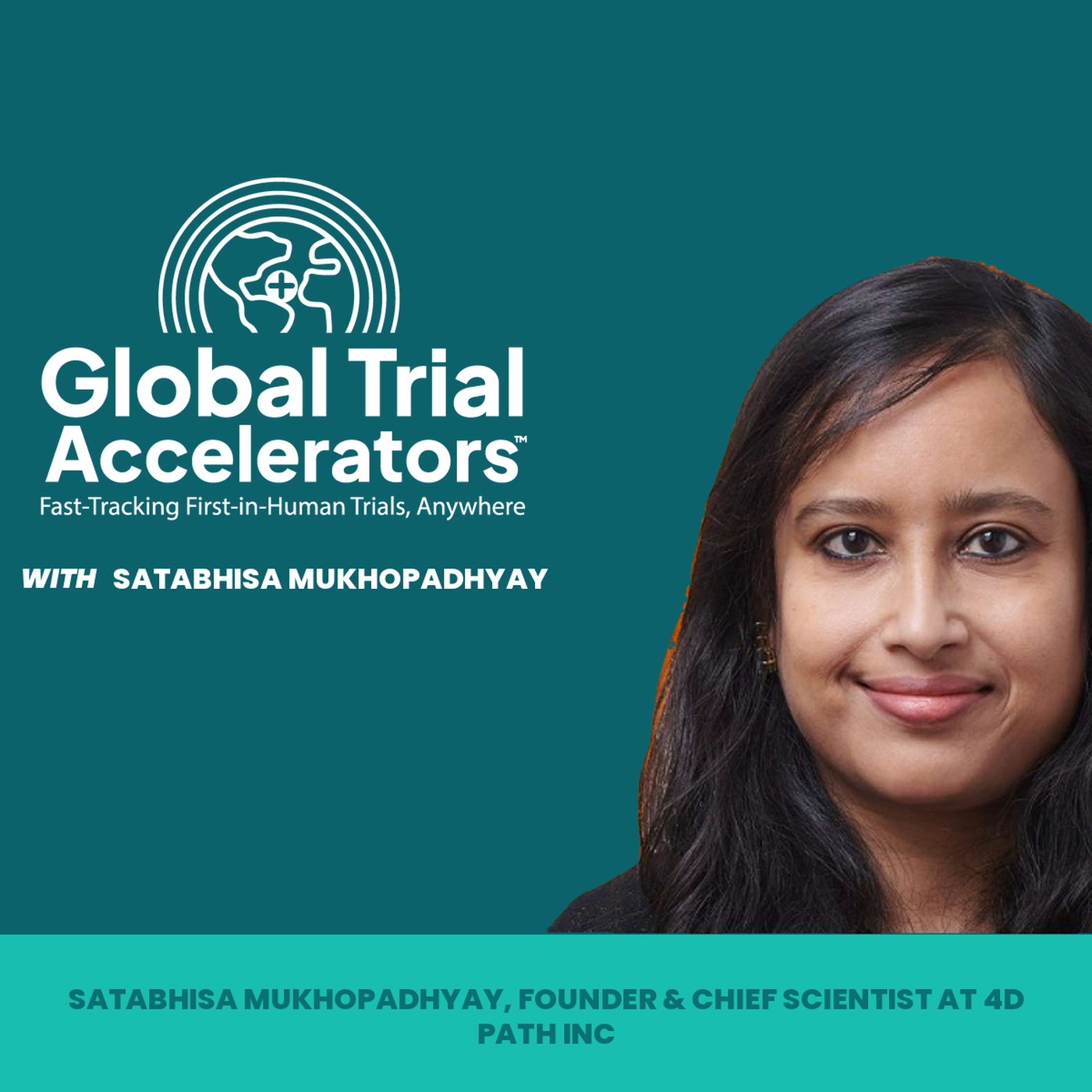
In this episode, we speak with Dr. Satabhisa Mukhopadhyay, Co-Founder and Chief Scientific Officer of 4D Path and co-inventor of its QPOR™ technology.
Dr. Mukhopadhyay discusses her journey from theoretical physics and applied mathematics to cancer systems biology, bioinformatics, and AI/ML. We explore how physics-informed algorithms and computational approaches can transform complex biological data into actionable insights for personalized cancer treatment.
She also shares insights into 4D Path’s clinical trials, predictive diagnostic technologies, regulatory strategy, and the challenges of translating AI-driven innovation into real-world cancer care.
Jesus Moreno (00:01.538)
Welcome back to Global Trials Accelerators, the podcast where we dismantle the barriers to clinical innovation and explore the strategies driving the next generation of life-saving therapies. Most conversations about AI in oncology sound identical after a while. Bigger foundational models, larger datasets, and better pattern matching. My guest today took a radically different path. She trained as a theoretical physicist and did postdoctoral work in applied mathematics at Cambridge.
Before spending nearly a decade in cancer systems biology across Harvard Medical School, MIT, and the Broad Institute. Out of that intersection, she co-invented a platform that reads a routine static H and E biopsy image and predicts how a tumor will respond to therapy. Crucially, it does not do this by learning what cancer looks like.
Computes the physics of what the tumor is actually doing. The platform is QPOR and her company for the Path is proving its power in the field. They have completed six clinical trials across multiple cancer types and therapy classes, including a triple negative breast cancer trial, a now entering phase two bladder cancer trial and launching an antibody drug conjugate.
Jesus Moreno (00:02.018)
Dr. Satavisha Mukhopataya, welcome to Global Travels Accelerators. It's a real privilege to have you with us in the show.
Satabhisa Mukhopadhyay (00:10.727)
Thank you, Jesus, for having me. yeah, I'm excited.
Jesus Moreno (00:17.272)
I'm glad to hear it. I would like to start with that transition few scientists ever attempt. You were working on string theory and fundamental physics about as far from clinical oncology as a career can get. And what what
mm moved you to do that transition. What was the catalyst to pull you out of the theoretical physics realm and refocus your mind in cancer of all things?
Satabhisa Mukhopadhyay (00:54.225)
Yeah, that that's a great question. And that reminds all of us that when we do science, we might be doing physics or chemistry or maths or engineering, biology, different. We start doing different things. Maybe it's compartmentalized, but at the at the end of the day, all of them are part of natural science. So when you are trained as a scientist, as a physicist or theoretical physicist, you were trying to describe nature.
in a in a certain scale, scale of electrons, protons, but then what happens in chemistry or in biology in inside a tumor in clinic in day-to-day life, nature also plays a role there. So natural laws, all of them are natural objects. So you have a you develop a view of natural scientists with the time if you're truly immersed in one of the scientific disciplines. So you can always apply
What you learned at and in in one discipline is is one way of seeing nature. You can, as a natural scientist, if you are true natural scientist at your core, you can always take take it there to the other problem. That's what actually happened to me and happened very organically. And like when I was growing up, my my grandfather was also my friend, philosopher guide and mentor in childhood, he was also a professor of physics.
back in Calcutta. and he always said that you want to do theoretical physics. One day you never know. You will apply it to biology in in clinical research setting, like all great physicists done that. Schwaringer did that, and then Feynman, Richard B. Feynman did that. So that was a note back then, just reminding that we are natural scientists at the end of the day.
But how it in real life unfolded that when we were doing theoretical physics in in during my PhD at that point of time, the theoretical and we were describing our universe with string and gauge theories, there were a lot of mathematical structure that evolved, a lot of rich mathematical structure, but there was much less data. And when the data were coming from astrophysical experiments, there were like mismatch. So
Satabhisa Mukhopadhyay (03:19.633)
So there was some some kind of transition, some kind of quest that and suddenly we came across with in an interdisciplinary setting other scientists from systems biology who are saying you have a lot of tools, one language of seeing nature, but there are a lot of data that are unexplained in biology, in in cancer research. So why not give it a try? It's nature too.
And so very naturally in one of our work, like my longtime collaborator, my husband is also longtime collaborator, he's also co-founder Foodie Path. So in our long-term research, we actually could explain some of the some of the findings of insistence biology, some of the puzzles of how evolution can be faster. So that that created interest and very organically from there
Where I I came to first in MIT and I was doing AIML bioinformatics on real life, high throughput data. And then I again this natural scientist quest. the quest was that you you are you are reading the blueprint of DNA and our transcripts and you are learning a lot. But beyond that, where the dynamics is taking you to the post-translational modification and protein. So
I came to Harvard Medical School in Systems Biology and System Pharmacology with that quest that what are the dynamics there? When people do understand the dynamics, protein transcripts, RNAs, DNA, these are the language of of the in the tumor world, in the or in the normal cell world. These are the language of dynamics. So there is already one biochemical representation and then biological representation. People understand that.
But how to in an abstract way do that dynamics, get that dynamics out so that we can automate and faithfully take some decision, apply in real world. So this was kind of a very organic. In other words, it was very organic. It's just a quest of understanding nature more and more. And also like, you know, disease and treatment and cancer touches everyone in every family. Also, there was this thing that maybe
Satabhisa Mukhopadhyay (05:48.424)
We can make sense of these dynamics and then apply. How about applying to the real world somewhere? Like I like I in my personal life, I when my daughter was born, she was born 900 grams pre-trauma. I had toxemia. So I had to stay in hospital for one and a half months, right? So I saw that world too when in in in every one of our in our family.
There were many points we were touched with the you know, interaction in the hospital, so all of them together. like it happens in human life, but I would say the quest of a natural scientist took took us here.
Jesus Moreno (06:32.594)
That's that's wonderful and I love how you see that interaction between the natural sciences. Sometimes information is siloed within a specific field and finding those you know bridges between them can open the realm of possibilities for for science and advancement. So I applaud and and congratulate you for that openness and
The willingness to engage with with other fields. But you didn't abandon physics. You brought it with you directly into pathology. At the core of your work, there's a fascinating premise, that a static HE slide, a fro a frozen snapshot of of a tissue, contains the full dynamic behavior of a tumor.
the cell dysregulation, the microenvironment interactions, if you know how to compute it, if you know how to read it. When did that shift from a theoretical hypothesis to something you knew you could actually code and execute happen? How how did you realize the information was there?
Satabhisa Mukhopadhyay (07:53.084)
Yeah, that's great. That great question. So while so from doing physics inspired or sometimes physics informed both ways, algorithms for high throughput AIML genomics, there were some you could get some dynamics but not all the way, and so I came to Harvard Medical School was studying the immunofluorescence images of cells and and actually
not to get lost in translation. So different compartments of science are like different having different languages. You might get lost in translation. So I had to learn how to do experiment myself too. I just did that because I never I was with always paper and pencil, but I learned it. And then we're trying to see in cultured cells or sometimes primary cells with stain.
The dynamics are encoded by stain. We we track dynamics by stain, right? So I was doing different things and I was I mean, I was fascin I am fascinated by color too I paint. So I I would spend a lot of time with all the colors, all the stints, and Harvard Medical School had a lot of grant too for that in that time. It was early two thousand. And so I was getting familiar with
How the proteins dynamics in terms of cult asynchronous population of cells happens in normal cell, different cell lines or primary cells. But always it felt that one A that we have to stain everything to get something, and B that that so that that's like really costly and sure it'll give a lot of knowledge, but it's very costly way of doing that, and B that like
it in real body, in human b how do it's it it it appeared a lot of you know, a huge gap to go from there to really asking this in in in vivo, right? Lot of lot of layers, layers are surrogate to each other, how much they're translating or not. So appeared there was a like quest of like there must be something else. But we were doing on us in academia, I think
Satabhisa Mukhopadhyay (10:10.927)
the cultured cells, asynchronous population of culture cells or primary cells who are interesting too. But it was not really a tumor. And as a physicist I was thinking that there must be some way. Maybe there is some in mathematical tool that can really capture it. So that was there, but not much could be done on on on on on just cul immune force and culture. So it's I mean you could do a lot of interaction dynamics but not the
the overall dynamics. But then during that time, there was always there some innovation that that gives you way to take this thought, right? There were we saw the image of you know HN image was digitized. And like when you buy antibody their histology, you a little bit see the expression. But being able to see this tumor in terms of this
Histology means it's like a city, a lot of structure. And we saw that like it's it's there is a dynamics, dynamics hidden there. So, and that's a cornerstone, that's that's really diagnostic, that's true, coming from truly from patient. So we thought like we need to jump into that. And me and my husband, we thought
We need to jump into that and find the dynamics out of it, which is like really a like a blue sky, because you were jumping directly on these images and do that. But because of digital images, it was available publicly. So so we we actually came out of academia and like founded the company just to do that. Then how about when that patient
comes in interaction of with the interaction of their diagonals, they are they have the interaction with the clinician, right? The the first time they have diagnoses, they have, we were sure they have all the information in that tissue. But we need to find it out. And as physicists, like you said, I will always start thinking like a physicist, we knew like in when we have the cosmic micro background radiation,
Satabhisa Mukhopadhyay (12:31.063)
From the far past that traveled and reached us, we can extract dynamics from that. Physics, there is one beautiful thing here. I may little bit emphasize in physics that say you have a complex system, you want to take a dynamics out, right? From extract the dynamics from there. But physics gives you with minimal it gives it does two things. One, for sure, if you have macroscopic variables.
and and some microscopic so you learn few microscopic things and you can connect to the macroscopic almost like genotype to phenotype mapping but you can do it in a testable way it's not just learning and pattern matching you can do with the causality so having known some microscopic detail you can map to macroscopic and you can track the macroscopic to validate it and B if you have a complex system even though you have a very
complex hard system various layer to track and lot of interaction you don't know you will never know everything of a complex system right but what physics does gives you with minimal number of microscopic variables you can abstractize the system in such a simple way transform a transformation to abstractize the system so that you can easily s easily find out the short term and long term behavior so going back to that without
complicating further. So like we first liked the fact that there is an HE that a clinician will always generate. It is it is cornerstone, it is diagnostic, it comes from for for me, the exciting things come from the tumor itself. It's a representation of the tumor. And to me it was like a it is a snapshot of an asynchronous population of cells.
Sure, pathologists have hundreds of years of mapping from different they have very good dictionary with experience of hundreds of years that's some feature to to prognostication, prognostic factor. You have a feature. If you have this feature seen, then there is an outcome mapping that this may happen to you, or you have this risk or not. There was this dictionary, but
Satabhisa Mukhopadhyay (14:56.103)
We saw that cells were cycling before putting fixing. They had dynamics. So it's just like asynchronous population of cells, frozen in just frozen at one point of time a snapshot, but still had the dynamics. And we know from physics that the correct abstractization of system is statistical physics, where you have some underlying dynamics. That means if you take a snapshot, you have representative from different parts of the dynamics.
So, in other words, you have using statistical physics you can extract that from the system which which we have done in black hole and cosmology. That's what we do. We could not go back travel far past during origin of universe and we could not measure there. We could not stain or do calorimetry, but with the the signal travel at some point it has
All the information that got generated at every point of time. So we are taking a snapshot, but information are coming from different layers of time. We retrieved that with statistical physics. So this can be done here. And other thing was so that was the thing. We really like that. We want to democratize access, easy compute, compute close to fundamental, then it will be easy compute and more reproducible.
And compute in a way that you are adding extra information, you are not increasing a payload. So that system was very appealing to us. Then we founded the company, raised money, and we wrote the algorithm and initially we tested from public images that yeah, concept is correct, but then we there was a whole lot of journey today. We are successful and multiple trials and now really we are
expanding to be pan cancer. We hope that this is a pan cancer phenomena because the dynamics you are extracting is none other than the very fundamental natural phenomena of cell cycle computed by statistical physics of the cells interacting in a static image.
Jesus Moreno (17:16.655)
And if that wasn't complex enough and layered enough, you also built predictive models in quantitative finance before founding for the path, and you layered those into this algorithm, if if I understand correctly. Combining physics, quantitative finance, and cancer biology gives you something that that
it's very niche, very unique. How did that mix of of layers or lenses if if you will, help you see the problem differently from what a traditional biologist might might see when when they approach this HE snapshots.
Satabhisa Mukhopadhyay (18:08.251)
Yeah, yeah, I think the f yeah, so physics really helps in in in finding I would say the what is the most fundamental dynamics of process the at systems level that you that system is doing. Like tumor, it has tumor cells, it has immune compartment, it has extracellular compartment, everyone is very complex layers interacting with each other. And when you give a dra with by interacting with each other.
Normal versus cancer cells, many of these interactions are deformed and redesigned to the convenience of the tumor, right? And so you are you are already seeing a system that got deformed out of balance, and giving a drug is like a perturbation. You exactly don't know which direction it'll go, right? So because it's a complex dynamical part-the system and the perturbation you are giving.
You are trying to see tumor vulnerability as a deformed system, giving choosing, selecting a perturbation in precision oncology, such that you want a desired outcome with less less adverse effect or toxicity, right? Now, it's a so as a physicist, like I explained that when your entry point has a lot of hidden dynamics.
And as a system to look at take all the compartments and look at as a as a whole system, part of system, what are the nature of perturbation? The most faithful way you can know that is going to the underlying fundamental dynamics that they the system, all the tumor system, normal cell, all organs, they all of them will have cell cycle, and that will be deformed, has will have overall deformation because of.
Interaction of different compartment. If you read those deformation, that's your most complete quantitative description of the vulnerability, which you can match with the external perturbation to go to sudden direction, right? So, for example, if the tumor very simple, if you could find the overall proliferative state of tumor, then various you could do various stints or different compartments or
Satabhisa Mukhopadhyay (20:31.249)
So more mitotic count or KI67, those are different projections, different dimension of seeing that, but not the total dimension. If from cell cycle, you in overall cell cycle, you could compute, imagine the total deformation from this proliferative state, and the proliferative state it ha is higher, meaning you may have better chance to hit the cells and kill.
with chemotherapy. So maybe that will drive the cell to like responder, responder direction. But if the if the tumor has had a lot of heterogeneity, intrinsic and ext extrinsic from the ex extra tumor, extracellular compartments and and maybe molecular heterogeneity, clonal heterogeneity, all heterogeneities will you could sense in the deregulation of geo checkpoints and they
Will drive you away from the responder status. So just by finding this overall deformation and doing scientific hypotheses based on 20 years of 25 years of tumor cell biology, you could make it to predict. And to going back to your original question. So what we did essentially as a physicist, and that's that's a tendency when you have complex layers, you have different microscopic information from different layers, right?
You are trying to build a model to get a macroscopic direction. So the statistical physics is a way to abstract a system right way to get the how this whatever you know in an incomplete way of the microscopic that can be translated to a macroscopic effective dynamics, the essential dynamics, so that you can predict.
And same for just to touch base on finance. So this is the universal lens of physics for any system. So in finance, you'll have the market has a mind, right? And the mind fluctuates. There are many microscopic details that can fluctuate, but the market moves is a macroscopic move. And there were certain, it was exciting to see that there were certain like processes, sudden microscopic thing, but together you can extract
Satabhisa Mukhopadhyay (22:53.977)
this macroscopic direction so that sudden processes are relatively persistent, relatively slow moving and suddenly changes changes like sets or tips, right? You want to find that point. But same idea can just seeing a market as a system and through this lens you can similarly get this out. So it's it is like a like a lens of way of describing
and understanding and extracting essential dynamics of the system is more that than like really really depending on nitty gritty details like which you will need anyway you will need some microscopic description that faithfully is tied to the dynamics in this case in cell cycle which is nuclear information and all we needed this nuclear
content, nuclear area, this kind of fundamental fundamental quantities. But that translated to the dynamics and we could take a decision just like in the finance side, some decision could be taken. And I would add another point here. What I learned from finance life that was useful. It was not only writing, not only seeing the system in a new way, just like we're doing in cancer and writing an algorithm, but it was
It was like tied to market, the market it was building in into an automated system, market data coming, you do this computation and then give back decision. It's it was an algorithmic trading platform, it trades, auto trades, and so it's like a it has a it is not only the computation but also exchange with real world in an automated, faithful way. And and we and we thought that
I mean, if we can, that was the like inspiration that let's take the biopsy images. That's cornerstone, that's always available. We're not asking any additional tissue, right? We're not putting any burden, but there are mood dynamics, take it, compute, give back to real world completely out of sample, and may and see that the whether the decision, how was the decision? Did it help? Was it informing the decision?
Satabhisa Mukhopadhyay (25:20.997)
And if we can do that, it's a clinical trial. I mean, what is a better way of automating a clinical trial really informed way? And that's the path we have taken in Puri.
Jesus Moreno (25:33.833)
That's a f full gamut of experiences and connections, but i if I understand it correctly, it's applying fundamental principles to any subject matter and understanding it as a
analyzing the sist systematical structure of it and and the dynamics that the it system has and translating that into the universal language of mathematics and and you f start seeing those patterns between different very very different fields. and and you pointed out at the end what what I would like to
Go deeper on the clinical trial aspect of of what you do with that data. So let's look at the translation translational gap in oncology trials. You've lived the entire path from mathematic abstraction to clinical trial deployment. Where does the primary friction show up when when you take a physics-based biomarker model?
Satabhisa Mukhopadhyay (26:24.018)
Yeah.
Jesus Moreno (26:50.135)
and attempt to integrate it into real world trial workflows.
Satabhisa Mukhopadhyay (26:56.337)
Yeah, that's a great question actually. In real world you have much less window of time to take a critical decision and this helping in this decision should matter to be able to use the any help any test is giving the biomarker in a way that it's it's accessible to everyone and not creating any load. The the friction is like you have a you
Develop something which is scientifically viable to you. The moment you come and put in this delivery system of where you are interacting with the real world, there will there are enormous barriers. And the way to minimize that is that from the very beginning, think about how this will be used. Who will be using how this will be used and be in their shoe from the very beginning. Like we did in in the finance.
side it is not that I can compute this and let me test it it is giving good performance and then I go and implement. So it you have to be in when you are developing some end-to-end platform for a real world use at from a very beginning you have to know the when an oncologist is taking a decision where is the pin point what will matter in that moment of time and for a pathologist how that pathologist is delivering
things, the results to oncologists are in a tumor board. What are the essential point where it matters? Because your value proposition would be not only giving a performance, but it should matter a lot without creating a load. So in other words, long simply put, we whenever whenever we're writing an algorithm, would always think about this entire pathway.
and to know the system, describe and deliver, and really think about the end user that how it is possible they need this. Physics can compute physics and tumor biology can compute this. How it'll where it'll matter to deliver in a way it's viable. So I would say this real world component has to be embedded from the very beginning in developing this algorithm and platform which you have done.
Satabhisa Mukhopadhyay (29:19.207)
We checked like really s say in some cancer, like say new adjuvant, triple negative breast cancer, you don't have I'm just giving example to bring my point forth that you don't have ER positive, heart positive, PR positive, triple negative. So you don't have many targets that you could do. So it's really in a personalized way who would benefit from some, you know, heavier treatment.
versus less treatment, how the clinician will go and and this is an aggressive cancer, can metastasize easily. You you want to do as a clinician, you want to do an oncologist, you want to do it right as much as right in the first time given patient's condition. You don't want to poke the tumor and let the tumor think to find alternative way, because if you had partial response, it would happen. Tumor might find a way to, you know, come back.
So it's important. But here there are not many biomarkers. There are some prognostic factors like high stromal tilts can mean that clinician can give this treatment confidently. But again, there are responders of low stromal tilt. What will happen to them? There may be non-responders of high stromal tilt, right? So so knowing that what matters in that setting, what actually matters.
Not wasting their time, patients' time, and actually would be a true help. And how you can connect that from the already available thing. They don't have to do a thing only other than digitize, digitizing these images. So so we're starting from digitized image, turning image to fundamental observables that are deformation of cell cycle, that are reasonable biomarker.
So the moment and and in cloud since we are doing CPU based computing, we're extracting the core core observables, like key observables, and so we don't have to compute much. So in in a sense if if you are using physics informed computation, physics informed AI, you are essentially extracting the core dynamics so you are not c computing many more things. You're just
Satabhisa Mukhopadhyay (31:45.342)
Doing the essential thing. So you can do one CPU or CPU based computing that's less cost. And in near real time, you can deliver something that that is first of all can be in a scalably in a in low cost can be validated in clinical trials. That's what we are doing through the trials, and it mimics the how they will use. And so we had to keep all of this in mind. Where for first of all, we made
This initially this criteria that start from digital image that'll be there, H and E is there, H and E's cornerstone not going away, and we are trying to make H and E useful and work on a problem that has no biomarker, but people want to have a biomarker because it'll make sense. They can easily figure out, yeah, this gave me some benefit versus not. And then and then give in a way that that that that
that just that are timely and easy access and and and can be validated with standard procedure without much trouble. So all simplistic I I would say you can design there's there's OCOM razor, right? You can if you're doing right thing you can design an OCOM razor for clinical trial having an into an RM edit pathway and we focused on that.
Obviously, we had to solve a lot of problems. Like, for example, HNA would be highly variable from in real world. That's the thing, highly variable across the labs. There can be many variability in technical artifacts. Like there can be technical noise. There can be a lot of noise, right? So we focused on suppressing technical noise, but not in a way that you will lose biological noise. The biological noise are informative.
A biomarker is actually testing the biology, bringing the inner biology of the tumor out in a in a valuable way so that people a clinician can make decisions. And so we focused on smooth delivery where it will make sense in a sure, simply put. But and we we try to do that in a way that we are competing at fundamental. So less compete, less cost, all easy.
Satabhisa Mukhopadhyay (34:11.183)
rapid turnaround with rapid turnaround is less cost and democratically accessible and then we focus on essential thing that there will be real world the main problem is there will be real world noise how can you compress that and but keep the biological variability that will give that true personalized response and then how it will mean for this entire trial path.
way. We from the very inception of of of developing a biomarker, we were in touch of reality. In a try to think in a different way, but in t with with with the touch of reality so that it is viable. And then we're testing that in a clinical trial format.
Jesus Moreno (35:03.471)
Well, there's so many layers. but as you pointed out earlier in in this last comment, the sooner you you get this technology, this information in the hands of of the end user, the the oncologist, the better it is for the patient and the
More information you can gather about whether it's going to be useful or not, or how is it going to be used? So engaging early with oncologists and pathologists, how did that interaction gave give you feedback into what the the platform was turning out? And how has their feedback changed the product assign for the platform?
Satabhisa Mukhopadhyay (36:01.339)
That's a great question and yeah, I mean we learned a lot from all the oncologists and pathologists, all the KLs. We have great KLs and from very beginning whenever you said we want to get this cell cycle deformation out and from just from the image, unannotated, anonymized, no patient data, just the image. We want the hidden dynamics out without using patient data. So it's a out of sample model and want to validate
and see if it helps you in the contest want to learn. Everyone, everyone was enthusiastic. It was very smooth collaboration everywhere. True that there are some paperwork here and there companies working with academic setting or community setting. There will be paperwork, some lag time, but but as a all on all clinicians are scientists too, and and we had enormous synergy
And we learned a lot that what is important in that moment? Like where the actually you really need to learn from clinician where the patient will be benefited the most. And maybe your algorithm can do a lot of things, right? But you would put your energy where the patient will benefit most because the algorithm's power is to simplify complex problems.
The the clinical problems are complex, tumor is complex, algorithm is simplifying, complex problem to simple solution. Solution has to be simple, less burdensome on the clinical pathway. Now learn where the simple solution makes most sense and people can test it without much burden. So we learned a lot from them. It was very we're very thankful. We learned from everyone. We have great cows and
It was does they helped us to see that yeah this matters if I have this tumor in this organ, why I'm giving this therapy, this matters. And it's very easy then to translate that what is essential in an algorithmic platform, what is not. And and that helped us to like we did it could be applied to many settings like we did in TNBC trial, we had three successful TNBC trial and now we're launching a pivotal TNBC trial.
Satabhisa Mukhopadhyay (38:21.647)
So I mean from the very beginning it was clear that work in a setting where patients have nothing, clinicians have nothing to decide other than whatever is available in standard of care. But there's no informed decision making. Of course, they decide based on their experience, seeing the patient. It's a very physical thing, seeing the patient, how the patient is doing and what has been in literature. there are things, but
Maybe an another point, I'll t this is very important in in today's age. Today there are a lot of research and a lot of interesting drugs are coming. After chemotherapy ADCs are coming. Like you have you have double, it's a targeted chemotherapy. You have bi-specific, trispecific, and each of these drugs has a specific patient population where they will really work. So there are a lot of research and a lot of drugs coming which will really work.
But may not work at all for the other patient, and that patient may have bad consequences. So it is it is way more like you are giving way more tools or weapons, but it you that there is it's hard to make decision from this choice because you want to give the right for that patient that time the most right the therapy that would be best for that patient given the condition. So
So here standing here that where the pain points are, where the patient will be most benefited and how they want it really guides you.
Jesus Moreno (40:00.633)
Doctor, and you've mentioned participation in in several different trials and and patient groups, some of them even that some populations that are usually written off as non-responsive, like immune infiltrates. which clinical results best describe or demonstrate what QPOR can achieve?
where traditional methods fall short. What what have you what has the clinical trial uncover about how effectively the platform aids the oncologist's efforts?
Satabhisa Mukhopadhyay (40:45.745)
Yeah, that's a great question. Like I said, we we actually it's a suite of biomarkers from reading deformation from different parts of cell cycle. But the we started to work on breast cancer as a beach head area and then now we these biomarkers diff for different classes of therapies, now we have successful results in melanoma with the same biomarkers, the same
core computation, but it's just the organs and the therapy classes change. And some of them are more informative in some certain settings, some of them are less informative in certain settings, but all of these biomarkers are important. And we now have same biomarker suit applied to was successful in melanoma, then ovary and cancer, then colorectal and
Also, we are seeing success in non-small cell lung cancer. So we'll go on and for different organ, different therapy, some some biomarker would would these biomarkers are informative, but some of them or a one single of them would be the best biomarker for the setting as chosen by clinical trial. Having said that, since we started with breast cancer, we did we did a lot in TNBC and now we are launching a pivotal trial.
In triple negative breast cancer. so I would say one of the really great candidates that we are seeing is our complex immune response signature. And it is this complex immune response is is has three three way information. It gives information in three ways. It's a composite of proliferative status, and it's a very nice hypothesis that if the tumor has high proliferative status.
then you are likely responder to chemotherapy, chemoimmunotherapy. And but then we have immune heterogeneity that that takes you away from the responder status and the G1S regulation takes you away from the responder status. And for TNBC for predicting neoadjuvant chemoimmunotherapy and chemotherapy response. This is one of the
Satabhisa Mukhopadhyay (43:11.847)
candidate bi marker that we are pursuing to a lot of depth in a big trial already it showed initial success in retrospective valuation of phase two trials and tuning in TNBC trials. So I we are very ho we're very excited to take it to a large population in multi-center trial. And this will be very useful because if you think about it that you will be predicting from pre-treatment
when the patient is diagnosed pre-treatment, pre-operative biopsy, we'll be reading out how vulnerable is this tumor, so to and how well it will respond to chemoimmunotherapy or chemotherapy in terms of the standard clinical metric. Their post-operative pathologic complete response, PCR, and three year CFS, which is very
important for TNBC. So we're very excited about that. And outside that there are other results that will be published and only I can talk about it. In other organs we have real success and all of these are viable. We are it's not only chemotherapy, chemoimmunotherapy working with ADCs and Bispecific and a lot of things are being added. We work actively targeted therapies where this apply to any class of therapy for any tumor but
Only certain aspects of tumor, like maybe for some tumors, G1S and GTM is most informative. For some tumors or for certain therapy classes, tumor maybe the proliferative status and the complex immune struct responses will be informative. That will be blindly validated in the clinical trial. But it's a very useful suite of biomarkers that
QR platform is giving for in a pan cancer and pan therapy where it gives a lot of power to the interrogators to find right population matching to right therapy.
Jesus Moreno (45:20.249)
Doctor, it's been a wonderful conversation, very informative, eye-opening, mind blowing, even seeing how all this different fields and and perspectives can add up to in a new way of of extracting information. And for me, the central takeaway from today's conversation is is that data
Data we need to predict how patients will respond to complex therapies, even beyond cancer, is often already sitting right there in in the routine biopsies and routine tests. but what's what's the the breakthrough here is not collecting massive new data sets, but rather applying the right physics to compute the information that's hidden in those
data points that we already have. Dr. Shatabaisha, thank you for your time, your scientific rigor, and for sharing with us your vision and yeah, letting us explore this intricate and complex and remarkably interesting topic. Thank you.
Satabhisa Mukhopadhyay (46:40.583)
Thank you, Joseph, for having me and I hope I didn't make description too complicated. whenever I start talking about science I I get dragged. But you beautifully nailed it. You beautifully said that often in your regular system there are more dynamics hidden that might simplify a complex problem to a simple solution so that you can use in real world.
people can democratically access, it may mean a lot, may change people's life. And that's what we are after. And we hope we the next generation will also do the same. It's human quest from time to time, from different ages and that's how we proceed. So thank you very much for having me.
Jesus Moreno (47:26.201)
Thank you, Doctor, and thank you for tuning into Global Trials Accelerators. If this episode challenged how you view your trial data, share it with colleagues that or clinicians that are in need of hearing this information. Subscribe wherever you listen to our podcast, and we'll see you soon in our next episode. Until next time, keep accelerating.