Apple Podcasts
 Spotify
 YouTube
  RSS Feed
 Daniel Zequeto, Founder & CEO at ODC Life Sciences
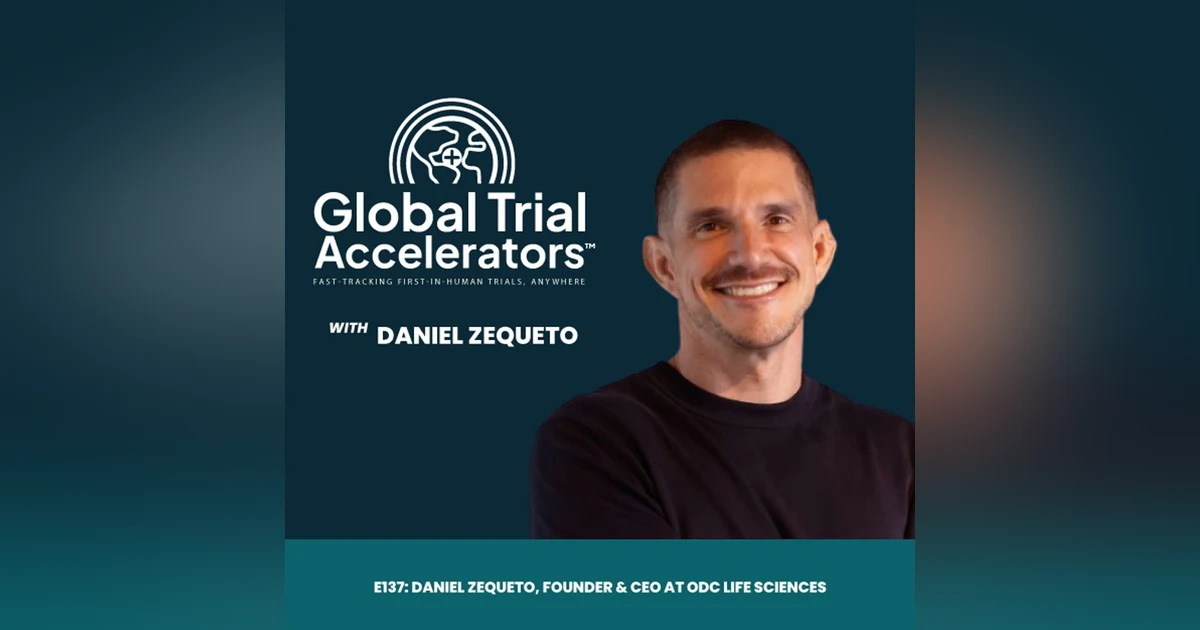

In this episode, we speak with Daniel Zequeto, founder of ODC Life Sciences, about the challenges and opportunities of conducting clinical development across Brazil and Latin America.
With more than 20 years of experience as a commercial and clinical leader at Abbott, Hospira, Shire, and Alexion, Daniel has worked on both sides of the equation and witnessed firsthand the challenges sponsors face when entering LATAM without the right local infrastructure.
Daniel shares his perspective on clinical development, early access, and patient recruitment, with a particular focus on rare diseases, hematology, oncology, nephrology, and neurology. We also explore what biotech companies and pharmaceutical sponsors need to consider when expanding clinical programs into Latin America and how the right local expertise can make a difference in execution and patient recruitment.
Daniel Zequeto is the founder of ODC Life Sciences, a specialized clinical execution partner supporting biotech and specialty pharma companies across Brazil and Latin America.
Learn more at odclifesciences.com.
Jesus Moreno (00:01.815)
Welcome back to Global Trials Accelerators where we dismantle the barriers to clinical innovation and explore the strategies driving the next generation of life saving therapies. Today's conversation is squarely about one of the industry's most persistent blind spot. What actually happens when the sponsor tries to bring a trial into Latin America without the ground infrastructure to support it? My guest built his entire company around this exact gap.
Daniel Sequeto is the founder and CEO of ODC Life Science, a specialized clinical execution partner working across Brazil and Latin America with a deep focus on rare disease in such broad areas such as hematology, oncology, nephrology, and neurology. Before founding ODC, Daniel spent over two decades on both sides of the equation as a commercial and clinical leader at Abad, Hospira.
Sherin and election, which means he sees the Latam access problem from sponsor side and execution side. And he is here today to share with us his insights. Daniel, welcome to the show.
Daniel Zequeto (01:17.71)
Thank you so much Jesus, thank you so much for the invitation.
Jesus Moreno (01:22.477)
Danielle, I always like to start with the why. you spent over 20 years inside Big Pharma in Biotech, and you've seen firsthand how it functions. So before starting ODC, what was the specific moment where you saw there was an opportunity? How did you realize how much value sponsors were leaving on the table? And
Was that the motivation to to start your company?
Daniel Zequeto (01:57.898)
It was not a click, but actually several elements that gave me motivation to found my company. My background actually, I entered in the pharmaceutical market because of a friend back in the days in the 2000s, I was living in California.
living my California dream, working as different functions as securities, car wash, valet parking, which gave me lot of humility, resilience, and value the hard work, and also made me a connection with the pharmaceutical company. had a friend who used to work at Abbott Laboratories, and I always want to actually...
I worked in a big company, you know, and the pharmaceutical market was already a dream for me. I was able, actually, to enter in Abbott back in the days, work specific with the spin-off of the Hospital Business Unit division, which became a company called Hospira.
hospital afterwards was acquired by Pfizer, was an MBA in the, on practical, like on a day-to-day hands, right? What was that spin-off and was inspired by other leaders as Alejandro Infante, which was already in the show here in the past.
After Ospira, I moved to the orphan disease, orphan drug market, the rare disease market, we were working at HCT Shire, a company who actually brought me how important was the patient centricity role, how important it is, we focus.
Daniel Zequeto (04:23.821)
on the patient and then work out our business pillars afterwards, which was great experience to structure LATAM and other countries, as Argentina, Colombia, Mexico, and the rare diseases space. And then I moved to Alexion.
Alexion focused very on the beginning on Rare Hematology Market, an amazing company that brought me
to my top level of how do actually we need to understand those patient journeys to actually help the physicians to identify those patients because they're so misdiagnosed. We were able to partner with patient advocacy groups, put together diagnostic programs.
in order to help those physicians to identify those patients and then create opportunity for those patients have access for a therapy that would change their lives.
Epolizumab definitely changed the disease pathway for PNH. And there was when I met the scientist Peter Hillman. Peter Hillman, grant mentor of mine. He actually was the one who clicked the trigger on me saying, Daniel, did you realize how many companies are missing?
Daniel Zequeto (06:25.613)
milestones because they are not being able to identify patients for their clinical trials. And then I realized that
those companies, unfortunately, they were spending so much money under the pre-commercialization of their drugs, know, understanding the pre-market of that. But they were not doing one thing before, which was how do I understand my patient journey for my patients, you know, previous on my clinical work, which could change their commercial pathway.
drastically and helped them to succeed. That was my critical moment was when I saw a competitor of Alexion, Appellis Pharmaceutical, struggling to recruit their Phase 2. They had huge challenges to recruit their Phase 2.
And Alexan was dominating the market back then for P &H. So I was even seeing, it's like, how come we're going to actually create other therapies? How come we will be able to develop other therapies to this patient population so they have actually next generation drugs for them? If those companies, small biotechs, mid-biotechs, they're not even able to recruit patients for their trials.
That was when the trigger came over and Peter Hillman said, I know that you're transitioning out of Lexion. I want you to introduce to Appellis Pharmaceutical for the CEO, Cedric Francois. And I think they would be of great help if you can talk to them. And was able to meet Cedric on...
Daniel Zequeto (08:37.325)
American Society of Hematology meeting in Ash, in Atlanta, more than 10 years ago, explained to him the rationale that actually patient recruitment, in my understanding, was not about selecting sites, it's about detailing the patient journey and understanding if countries have the combination that you need for your trial, right?
He gave me my first opportunity to support him with this rare phase two trial that they were having this challenge recruitment and we were able to be very successful. That was when the company began trying to solve
access pathway problem, not actually a site list as normally companies decide where to go and take their trials.
Jesus Moreno (09:50.897)
Okay, those four companies, very different cultures between them, how did that mm
Help you understand the strategy that a company must follow to plan their trial in Latin America and and how is that different? How is the planning aspect of the trial on paper different from how Latin America actually works on the ground? What difference were you able to identify in in those those four companies and their cultures?
between how they look at planning a trial abroad and how the actual trial unfolds as they execute.
Daniel Zequeto (10:44.012)
Well, I think those four companies, taught me a lot about...
We definitely need hands off and be boots on the ground, especially on Latin America countries, which we're still suffering a bit about bureaucracy, red tapes, and not well...
EHR systems institutionalized in institutions on this. But more than that, think especially Shire and Alexion. Hospita was, as I said, a day-to-day MBA on how to create a company, right?
when you have this opportunity to be side by side by the brightest Latin America minds that I had on that team. And you had this mission which was you need to transfer all the regulatory registrations approved from all the Latin America countries to a new company.
You need to create a company from scratch, a tax ID from scratch in all the four big markets in Latin America, Brazil, Argentina, Colombia, Mexico. And you need to create, build offices and a sales force for each of them. And you are able to participate on a journey like that. It's amazing for you to understand how do you actually... What's your...
Daniel Zequeto (12:49.516)
step-by-step plan, right? And how you need to, what do you need to do to create a company in each one of those countries. And when I enter in the Shire and Alexion world, the rare disease space teaches you how...
a therapy can actually change lives in a patient and not on the patient, their family, right? So the patient centricity that those companies create and the level of emotions also that was created on me, you know, on every single... I got to a point to realize that every single action on a rare disease company from...
the supply department, HR, finance will impact on the speed of those patients to get access to those therapies that will change their lives. The only hope that they have is those therapies. They spent years trying to diagnose their disease, years. And at the moment that they were able actually to have a precise diagnosis,
you understand how important it is to gain time in each one of those steps, or each one of those actions, so they have an opportunity to have a better quality of life with their family. That's what actually the Rare Diseases Space taught me.
And I'm trying to implement this into ODC. It's utilizing that knowledge, you know, by defining hands-offs, decision points, responsibilities, early warning signals, you know, that we can actually help to speed up those protocols.
Daniel Zequeto (15:11.276)
while still adapting the execution of each protocol, while in customizing our process for each one of our sponsors. So this is definitely a lesson that I brought to ODC. The speed and the patient centricity.
This is a culture that we, on a day to day, bring to the company. So... It's... It's... It's... Important, right? That actually, for you to work in ODC, you have that...
ability to not wait for things to get to you, but you proactively look for solutions and make sure that we are able to connect the dots and get a potation access for those trials for
each one of the populations that we are working on with either the medical referral doctors, the PIs, and the patient advocacy groups that we work on our trials.
Jesus Moreno (16:44.497)
I see. And well you've you've touched several different elements in in this in in this conversation so far. but I think one of the first
pain points or or friction areas of friction that that you mentioned was the regulatory aspect of of running and trial in in Latin America and and how some countries have sorry, what was that?
Daniel Zequeto (17:10.748)
yeah, the red tapes are...
Daniel Zequeto (17:16.063)
No, no, yeah, the red tape on the regulatory and the bureaucracy is huge. I agree with you.
Jesus Moreno (17:21.726)
Yes. And on on that subject, Brasil just wrote a new rule book for clinical research, Law fourteen eight seventy-four from twenty twenty-four, and more specifically the decree twelve six fifty-one from twenty twenty-five, which was published this past October. together they replaced the old C P and and KNAP.
double approval system with a new national ethics architectural review system. Correct me if if I am mistaking at any point please.
Daniel Zequeto (17:51.979)
Thanks.
Daniel Zequeto (18:01.194)
No, no, you're totally right. You're totally right. I can simplify a bit, but you're totally right, Jesus.
Jesus Moreno (18:07.239)
Okay. Yes, and and what my understanding is that this this changes the timeline for review. It it brings it from a hundred and eighty days down to thirty and opens the door for single CEP review for multiple trials actually. and the government has stated that they want to double the country's clinical trial and volume.
Daniel Zequeto (18:23.647)
Yes. Yes. Yes.
Jesus Moreno (18:35.721)
From its 250 study baseline and pull in a wave of new investment. so keeping all of those changes in mind, what is your take on this regulatory change? Was it warranted and does it address the real bottlenecks of clinical research in Brazil? And a follow-up on that is
You think this could be considered a blueprint for other countries in Latin America?
Daniel Zequeto (19:09.183)
Well, for sure we are celebrating a lot. You know, it's massive improvement for us. Nowadays on the Envisa side first, a bit like you have...
90 business days maximum review period where if an visa didn't actually pronunciate, you have a test approval, you so you have your protocol approved at the maximum of 120 continuous days, 90 business days. You have a reliance approval where a visa will...
approve your dossier without even reviewing if you have approval on a meaningful ICH country as there are several agencies, I think about 12 agencies all over the world that Unveasable would consider the approval of those trials. We haven't seen trials at our own on rare disease.
Daniel Zequeto (20:27.915)
using the reliance approval, getting approval in a bit more of 30 days. it's been proved that actually the new law is being effective. On top of that, the visa piece, visa actually grants import of records approval
even before the trial is approved so you can speed up on the sponsor risk, of course, to import the supplies into country so you have actually site readiness faster. And of course, at the beginning of the law, the idea would have actually to have only one approval for ethical and...
the regulatory piece. So, a visa would have one approval and you wouldn't need anymore the ethical piece. However, the law was changed and we still have to have the ethical piece, but it's in parallel. the possibility for you to pick a site which is
a site that would represent the national committee, right? And you don't need a double approval, a double review as you had in the past. Nowadays, with a 30-day timeline, it's even greater. Of course, this is on the ethical piece. This is... We're still running a bit of delays. You need to have a very complete dossier.
You need to actually do a test of stress to make sure that you don't have queries because if you have queries and you don't have a complete this year, you're going to have to wait until next month review. Also, you need to select the site and pick the site very well depending on your study because some of those sites, they don't want to submit the...
Daniel Zequeto (22:53.436)
ethical dossier before they have a CTA. So you need to work the CTA before. What we are doing right now actually we are...
Daniel Zequeto (23:06.468)
using the help of AI and our field team and our regulatory intelligence and strategy team to get inputs of all the sites in Latin America to help to use the technology to help us to decide which are the better sites for us to pick and what would be our lead site. So we run
We don't run any delays, you know, and we've been proactive talking with those sites to anticipate their CTA review in order to recommend sponsors for using their CTA or at least get on a midway agreement so we don't have delays.
on that piece as well. But it's amazing actually how these regulatory changes could dramatically impact the amount of investment in clinical research into a country. And I definitely would recommend other Latin American countries to follow the same path. I think they are.
We've been seeing progress in Argentina. We've been seeing progress in Colombia. I think you even can tell more than me about those progress, especially in Colombia. I would love to hear from you. I think we're going to have... I think we do have an opportunity in Mexico to be really transparent with you. We haven't tried yet with the new legislation, but I do have hope, right?
And I think we need to educate the world about all these regulatory progresses that we are having in our four big countries. If we get the population from Brazil, Colombia, Argentina, and Mexico, we have a bigger population than the five big countries in Europe, or the US and Canada.
Daniel Zequeto (25:30.866)
So, Latin America could change the clinical development pathway worldwide and we could be the mecca of clinical research with great science, great quality data, right on this, a unique diversity of ethnics, you're not going to find anywhere else. So, I even challenge a bit, you know, and...
Maybe it could be questionable, but I think that we could run phase 3s completely here, only in Latin America, and they could represent global trials. And they could be registration trials, right? We've been as a company trying to do this, promote Brazil, promote Latin America.
We're an event in MassBio now in September, end of September, which you're more than invited, Jesus, I want to invite everyone who is here in the podcast as well, September 24th, where we're going to bring people from the Ministry of Health and ENAEP to Boston, the president of the Pharma Association, Interpharma, which...
I used to be director from Visa, Dr. Renato Porto, and other KOLs and key stakeholder members, know, from the medical communities and the ecosystem that we have in Brazil to unlock this myth about Brazil, the regulatory challenges, and how progressing we are. And we want to do this actually with other countries as well because
It's definitely a game changer what's going on with all regulatory agencies around Latin America.
Jesus Moreno (27:40.753)
It's wonderful to hear that such progress is being made. The other the other element you had alluded to in your previous answers was the difficulty for sponsors to find the right population. And and ODC focusing on on the space on the space of rare disease, that's that's a difficult population to find by definition. So what changes in in the last
couple of years have sponsors implemented that you can share with us about how they approach patient recruitment for rare and complex conditions across Brazil and and the wider region of Latin America.
Daniel Zequeto (28:29.545)
I mean, one thing that we try to tell sponsors and actually nowadays sponsors are also coming back to us and understanding this is that recruitment is not about buying media, right? It's a whole different ball game, you know. ODC comes from...
my rare disease background, right? My orphan drug background. Actually, it's a funny thing to tell you. ODC back in the past would call it, would be called Orphan Drug Consulting, right? Which afterwards became Orphan DC, right? Orphan Drug Company, and nowadays is ODC Life Science because we are...
methodology, right? Not only work with rare disease trials, but any specialty trials that you have, you know, it's you need to identify unique populations as on college, know, neurology, nephrology, we are able to help. Even some of the knowledge and routine.
Retina Trials, we are able to help. think the sponsors are coming much more prepared and they're requesting us a omnichannel strategy, right? Nowadays, it's not only about, okay, let me see your assessment, let me see your site list, let me see your KOL mapping.
Let me see what's your tier one physicians that you selected, tier two, tier three. Let me see your diagnostic program. Actually nowadays they wanna say, how do you gonna use technology in your favor, right? What's your omni-channel strategy to educate that physician?
Daniel Zequeto (30:52.713)
What's your omnichannel strategy to engage that patient into the clinical, to the patient diagnostic program and afterwards educate that patient about the clinical trial. So when at the moment that actually he is going to the site for screening, he doesn't have any more doubts. You know, he's ready actually to be screening.
This is taking us out of our comfort zone. are in the process of hiring a new team, different experience, different skills to know that will complement the ones that we already have. And I think this is...
a fun ride to take to know where we're to develop a different new recruitment strategies and methodologies to how to actually identify those patients faster, support them, giving them comfort about where they are going to and being honest with them, of course, right?
Daniel Zequeto (32:23.015)
This is a possibility, right, for them, but it's not a promise.
Jesus Moreno (32:31.461)
So the omni channel seems to be the the prevalent strategy and more in more recent years, correct?
Daniel Zequeto (32:40.347)
I agree, I think so. think so, I think... Especially in Latin, I would say that the face-to-face interactions will always be on top of mind, right? We are... We are a community that loves to have face-to-face interactions,
This creates credibility. Sometimes we don't want to hear from an agent or AI. We need to actually have a face-to-face handshake to build trust. So I don't think digital strategies are effective in Latin. I think they are complementary, right?
So that's why I believe the Omni Channel piece is so important for us connecting the dots for our sponsors and working partnerships not only with the sponsors but also with the CROs. It's really important for us that we complement
the work because everyone wants the same object, the success of the trial.
Jesus Moreno (34:13.223)
Of course. Well, given given everything we've just covered, the operational gaps, the recruitment challenges, the red tape and regulatory shifts. if you were to advise a biotech CEO who's never run a trial outside the US or Europe, and is now looking seriously at Latin America, what's the one piece of advice that you've
you would give them before they they sign everything. What's the first step they should take in in approaching Latinwork?
Daniel Zequeto (34:52.873)
I would say that...
Daniel Zequeto (34:57.833)
Going to Latin America is a must. No matter what trials, no matter what indications you have. I would just say that not every country is for every trial. So select your country based on the type of your trial that you have. Not every site is for every trial, every protocol. So do it.
at least a superficial patient journey for each one of the regions that you want to go to understand if your trial is the right trial to be on that country and to be on that site. Don't only look for numbers on the feasibilities because those numbers, they may be real, but maybe they're not be possible if you don't detail the patient journey on how to get those patients, right?
I would, I think this is my best advice and don't wait for the perfect moment. Test. Initiate with one country when you decided that you have the right population in Latin America and you have the right country that you pick for your trial. Don't wait for the perfect moment. Come and test.
Do it a couple of times before, build trust with your partner, try to have someone boots on the ground, thinks like you and have a strategic mindset.
Jesus Moreno (36:45.311)
Wonderful. So it's it's about speed, about having a local experience partner, which ODC would be an excellent example of and maybe you can walk us through what what that means. What what does it mean to be a specialized clinical execution partner in the actual day to day and then how that
That differs from a traditional CRO.
Daniel Zequeto (37:19.954)
great comment, Jesus. I think the first piece here is that we want to work together, you know, as the gaps that the CRO sometimes do knock over, initiating by the...
landscape assessment on detail, the patient journey and each one of those country regions and having a very unique role that most CROs do not have, which we call the trial engagement specialist. The trial engagement specialist is not a CRA.
He is actually he works with the CRA in partnership to unblock
roadblocks, overcome roadblocks that the site might have to identify more patients, to activate faster, and to screen those patients faster. From educating about the disease,
potential diagnosed programs that we have it, that my disease have to identify those patients and kind of working as a case management until those patients are identif-mapped to, they come to screening.
Daniel Zequeto (39:22.112)
a bit as a right hand of the site and the CRO to make sure that everything is ready at the moment that those patients are screening. Another piece that actually is important to mention is that why...
because we do have the commercial experience that comes from me in the past, you know, the work that we do with the relationships that we create with the medical societies, the KOLs, during the whole phase two, phase three trials, it's already paving the way for those biotech companies that they have.
They're normally small, mid-sized biotechs. They don't have much resources or head counts around the world, but you're already creating, paving the way for their commercial endeavors in the future. Because if you're already educating referral physicians, if you're already educating the KOLs, if you're already mapping out referral sites and developing a continuum medical educational programs,
innovation series about the disease, the publications that that sponsor are publishing around the world. You're already creating potential market, right? That they have already at the moment that the drug, is approved. And one good thing that our countries have in Latin America is that
At the moment that those drugs are approved at the FDA, we do have named patient sales possibilities that those drugs could be accessed by other patients that are not in the clinical trial, but they can access this through named patient sales. And we've been supporting some of our clients with that end as well. Besides in parallel helping them to put together the regulatory dossier.
Daniel Zequeto (41:41.734)
to approve their drug commercially, especially in Brazil, as we have all the licenses and everything ready to submit those drugs and have regulatory approvals. are very lucky to tell that we have several cases, including Napelles that I told you at the beginning of the podcast.
where we help them from phase two to phase three to approval at the FDA and an visa approval under our name. We are being the market authorization holder of their drugs. And we have other clients as well that we are able to do the same.
So it's a bit of operating as the strategy layer, executing, paving the way for their commercial and the others in the future. Always working together with other partners in the process, the sponsor and the CRO. I think that's how we describe ourselves. That's why I...
I say that we connect the ecosystem in Latin America for clinical development, from clinical development to their commercial endeavors.
Jesus Moreno (43:23.476)
Wonderful. Thank you for for walking us through that process and as you look ahead for ODC specifically, but for Latin America role in global clinical development in a broader lens, what should sponsors, investors and the broad industry be watching for over the next couple of years? What do you think comes next for for ODC in Latin America?
Daniel Zequeto (43:52.186)
I think sponsors need to be watched and I think the clinical development market in Latin America is going to have a boom. I believe that. I'm stronger believer that we're going to be able to educate the rest of the world about the...
will prove of the real potential, right? And prove to the world that we are, we should be considered a top destination for clinical trials. But to do that, we need to build credibility with our sponsors, right? So as I said, we cannot take a reactive way, reactive approach.
about
Daniel Zequeto (45:01.639)
clean the clinical trials and to direct the approach of what's going on in the clinical trials. We need to actually take a much more proactive approach of what's those patient journeys, how we're going to recruit those patients, how we're going to identify them from the risk groups that they are and to randomization.
So it's a long process from actually how do they get diagnosed until they get randomized. And I believe that with the traditional way of how all this is doing things, I'm not even going to say the market, do you know? It's not going to be enough. We need to create omnichannel strategies. We need to include technology behind, do you know? And we need to provide...
We need to take decisions with database decisions and not only...
Daniel Zequeto (46:07.239)
or feelings that we might have or how we were taking decisions back in the past.
Jesus Moreno (46:17.791)
Wonderful. Danielle, thank you so much for sharing with us your insights. if there's one thing I want listeners to take away from this conversation is that access in is that accessing Latin America isn't the last mile of a clinical program. It excuse me. I'm gonna s say that again. I I completely lost my train of thought.
Daniel Zequeto (46:44.197)
It's alright. It's alright, it's alright.
Jesus Moreno (46:48.597)
Danielle, thank you so much for sharing with us all those insights. if there's one thing I wanted to have listeners take away from this conversation is that access in Latin America isn't the last mile of a clinical program, it's infrastructure that has to be designed in from the start.
Not blotted after a sponsor already has a protocol or a timeline they've committed to. that reframe reframing alone that reframing alone should change how a lot of executives listening to they think about their next LATAM decision. And I think you've helped us understand what are the variables to keep in mind.
what are the advantages and how promising Latin America is gonna be for biotech and med tech in the near future. Thank you so much for for being with us today, Daniel.
Daniel Zequeto (47:56.391)
Thank you so much Jesus, I think you actually got the message very right. If there is one last thing that I want to say for all the listeners is that please consider Latin America at the moment that you thought about initiating your clinical program, not as a last mile. I think you're gonna have great results of having
Latin America countries as the first wave countries in your clinical program. And it's not just a...
I wish that I have, but we have proven track records from other trials and other companies and other CROs that were able to be very successful considering Brazil and Latin America as their top priority countries.
Jesus Moreno (48:58.969)
And to our audience, thank you for tuning into Global Trial Accelerators. If this episode challenged your view of your trial strategy, share it with a colleague or client who needs to hear it. Please consider subscribing and we'll see you on the next episode. Until next time, keep accelerating.