Apple Podcasts

 Spotify

 YouTube
 RSS Feed
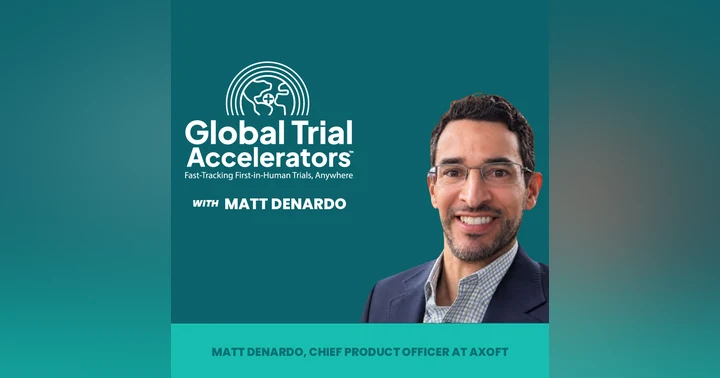
Matt DeNardo, Chief Product Officer at Axoft
In this episode, we’re joined by Matt DeNardo, a biomedical engineer and product development leader with a passion for transforming complex clinical challenges into innovative medical technologies.
Matt shares how his approach combines the rigor of systems engineering with the creativity of design thinking, enabling teams to translate unmet clinical needs into clear product strategies and successful execution. From aligning user needs and regulatory considerations to leading cross-functional teams through every stage of development, he offers valuable insights into what it takes to bring meaningful healthcare innovations to market.
Holding an M.S. in Biomedical Engineering from Northwestern University and a B.S.E. in Bioengineering from the University of Pennsylvania, Matt has spent his career at the forefront of medical technology, continuously exploring emerging technologies that can improve patient outcomes and shape the future of healthcare.
Planning your first LATAM study?
Matt DeNardo explores how specialist site selection, communication and documentation shape an early neurotechnology study. If your LATAM study needs to inform a U.S. submission, review bioaccess®’s guide to FDA consideration of outside-U.S. clinical data.
Jesús E. Moreno: Welcome back to Global Trial Accelerators, the podcast where we dismantle the barriers to clinical innovation and explore the strategies driving the next generation of life-saving therapies. There's a question every early-stage med tech company eventually has to answer. Where do you run your first in-human trial and why? For a growing number of innovators, the answer is pointing south. Latin America has quietly become one of the most compelling destinations for early clinical development, offering a combination of regulatory accessibility, clinical infrastructure, and patient access that is generally hard to replicate somewhere else. But the region also comes with its own complexities and the gap between what the company expects and what they actually experience can be significant.
Today's guest is living that experience firsthand. Matt DeNardo is Chief Product Officer at Axoft, a Cambridge-based neurotechnology company working at the frontier of brain-computer interface. Matt's work is defined by one core discipline, taking technically complex clinical demanding challenges and turning them into executable strategies aligning product, regulatory, and clinical execution from day one. He currently leads Axoft's first in-human trial in Panama, and today we're going to do a deep dive on what that journey has looked like. Matt holds MS in biomedical engineering and BSE in bioengineering from the University of Pennsylvania. Matt, welcome to the show.
Matt DeNardo: Thanks, Jesús. I appreciate you having me on.
Jesús E. Moreno: Matt, you started your career at the intersection of engineering and clinical strategy, but that combination isn't something that most people arrived at deliberately. I'm curious to learn if you could walk us through your background and how you began walking this path and what drew you into the MedTech sphere and how did your path lead you to where you are today?
Matt DeNardo: Sure, I'd be happy to. So, as you said, my background technically is in biomedical engineering, and that's a really diverse field where it spans everything from biotechnology, biochemistry, to medical devices, and kind of all things in between. I've focused in my undergraduate and graduate work much more on the medical devices aspect, specifically in biomechanics, and moving later as my career began to develop into bioelectronics. And early on, my first postgraduate work in the industry was at a company that was adding design services to their already well-developed medical device manufacturing capabilities. And so there, I learned a lot about what it took to bring a product to market, including the clinical studies aspect of it.
And that's actually also where I got my first exposure to conducting clinical trials outside of the US. The company I was with had done work in Paraguay for both cardiovascular devices as well as gastroenterological devices. And they had built up a relationship with clinicians in Paraguay that sounded to be mutually beneficial, where they were able to bring some new technology to bear at the clinics there. And in return, they were able to collect data that was used to further develop the device and later support further clinical studies submissions.
That was a really eye-opening experience for me, that coming out of school, you get very drilled into the very US-centric view of the world, where this is how it's done at the FDA, and these are the things you need to do to have an FDA-cleared regulatory submission, and here are the things you need to do for an IDE trial, and so forth. And understanding that there are other pathways that early in my career, I think unlocked the idea that there's more than one way to do things, and that there are benefits to other approaches, and those should be balanced with what the needs of the company are, the risk profile of the device, and the needs of the clinicians that you're working with in those other jurisdictions. I can go on to more about how my career developed and kind of led to Axoft, but certainly can take any questions on that early stage, especially that particular clinical trials experience.
Jesús E. Moreno: There is one aspect of that that I would like to explore further, and it's that work defining ability to hold technical rigor and product strategy at the same time, thinking about the device and developing the plan to get the clinical outcomes simultaneously. Was that something you learned in your training, or was it more of a product of experience?
Matt DeNardo: For me, it definitely came from experience, where I think this is a pretty common career path, where folks who tend to start off very technical are very much in the details of developing the technology and what its capabilities are, what its specifications are, and what's possible to do in engineering. And I think for me, learning early on that just because you have a good technical solution doesn't mean that you have a product was a very important thing.
And being at an engineering consulting firm helped me see all these different approaches, because at the engineering consulting firm, we were responsible for the technology. And the overall product development, marketing, you know, alignment with clinical need, usually came from our clients. So I saw across a broad spectrum of devices, how we could solve technical issues, but knowing that they were the right solution to go after in the first place, or that the device was addressing the right clinical need was something that came from our clients. And I saw both things that were really successful in doing that and things that weren't. And for me, it kind of shaped how I think about technology development throughout my career, knowing that you need to integrate the end user, the clinical need and the patient into your thinking early on, because otherwise you end up solving the wrong technical problem or bringing a solution to market that nobody wants.
Jesús E. Moreno: And I'm curious also to learn what brought about that transition from that early stage of your career towards Axoft specifically, was it about what was it about the company that drew you to them? Was it the mission? Or what more? What in that thought process made you think this was the right next step?
Matt DeNardo: So I think I had seen from engineering consulting that similar to what I just talked about that a lot of the challenge was that as consultants, you only have so much control of the whole process. And so I developed that kind of desire to want ownership of the complete solution, not just the technical solution. And one of the things that specifically drew me to Axoft was that they were addressing a clinical need in brain computer interfaces in a very unique way. And that was by designing from the brain interface itself outward. So they started with a material platform that the co-founder and CEO developed during his PhD work. And to me, that is just somebody who is really listening to what the industry needed and not just trying to throw technology at what they thought the problem was. And so for me, it was something that differentiated Axoft from other brain computer interface companies. And that type of thinking was something that really resonated with me, that I knew that going to a company like Axoft would lead to decisions being made in the technology development that were supported by the clinical need that we were trying to address.
Jesús E. Moreno: I see. Did the understanding that Medtech is a space where, you know, long timelines are reoccurring, it's a space where the development process from idea to a commercial product, it can take decades. Did that have any impact on that decision?
Matt DeNardo: I think after working in Medtech for so long, that's become something that's just baked into my thinking that there is a very long time horizon and more so when you're on the forefront of new technology and new clinical space. So I think everybody's going into brain-computer interfaces realizing that even the first generation of companies that we all hear about in the news have been working at it for 10 years or more at this point for some of them. And the clinical studies that you need to support regulatory submissions, the studies themselves can take years. So it's not surprising in that aspect of just how that's baked into my thinking is that, you know, you go into this knowing that there's a long time horizon to see your device even in use for the first time, never mind, accepted as a regulated medical device.
Jesús E. Moreno: And what keeps you consistently motivated to, you know, keep at it?
Matt DeNardo: For me, it's that we're specifically addressing an unmet need that has not really been addressed in any way before. And I think that the fact that it's a brain-computer interface technology makes the technology development exciting. But it's also like the thing that keeps me going day to day is knowing that there are patients out there that in the absence of this technology have very limited options out there to help them, even to help diagnose them in the future or help design treatment plans or to help treat them directly. And so that kind of guiding principle of, you know, there are things that we think we can do to help these patients is what drives me to develop this technology and to make sure it serves their needs once it gets to market.
Jesús E. Moreno: I see. Thank you. Thank you for sharing that very personal aspect of your journey. But I agree that I think the motivation is derived from the impact that technology promises. And speaking of that technology, I would like to dive into Panama now. When you're an early stage company with a first in human milestone ahead of you, the decision of where to run that trial is one that it's one of the most consequential choices you'll make. I'm curious to learn what drove Axoft to take a serious look at Latin America and how did Panama specifically rise to the top of the list?
Matt DeNardo: Sure. I think that seed was planted back in my first company experience, having done work at Paraguay. So I think there are a lot of folks who come up in their careers early on without that exposure. And that might not be the first thing that occurs to them, that they have their U.S.-centric blinders on and are looking for how to do the work in the U.S. And I think being open to the idea that the work can be done somewhere else, just that in itself is a very freeing thought where you now have potentially the whole world available to you, depending on the different regulatory restrictions and being able to work with clinical partners in those locations.
We specifically looked at Latin America partially because of my previous experience and because of its proximity to where we are in the Boston area, and as well that we're looking for a specialty in neurosurgery and that there were centers there with neurosurgery experience that was important to align with because we have a device that's used for neurosurgery. And so all of those things together said that Latin America is at least a place that we should explore. And in working through the exploration and ending up selecting a site in Panama as our clinical trial partners was driven by the clinicians that we met and were working with at that site. They had deep neurosurgery experience, had clinical trials experience, and I think were understanding of what we were trying to achieve as a company with this technology. And I think brought into the idea that this is potentially a life-changing technology for some of these patients and wanted to be on board with helping advance it even further.
The second thing that I note is the facilities at the hospital in Panama that we worked with were state of the art. And I think in neurosurgery and brain computer interface technology specifically, that having facilities that are modern, especially in terms of how they perform with respect to electrical noise, is really important for this very sensitive technology that we're trying to bring to market. So, neuromonitoring devices and brain computer interfaces in general are very susceptible to environmental noise. And so for use intraoperatively in an operating room with a bunch of other medical equipment that's being used at the same time, is we had to understand what the noise performance of the room and the space, the environment, and the other devices in the environment were. And having a more modern facility tends to mean that everything from construction standards to practices in the operating room and the relative radio frequency immunity of the devices that we're working with and what kind of radio frequency noise spectrum they produce, is much more understood and controlled in such an environment.
And then finally, the last thing that really appealed to us was a bit of good fortune and that from Boston to Panama City was a direct flight. And I think it was something that was not certainly our first decision criterion, but in now having lived through that experience, I can't overstate how important that was to be able to get a team to and from our clinical site within the same day. And I think for other sites farther south in Latin America, that was challenging, either physically they were too far away or that just flight schedules always required a layover and that layover could extend the trip for another day. And so the difference between being able to fly down and arrive in the evening, meet with the clinicians and be prepared for a procedure the next day is something that we're able to do in Panama where traveling to a farther location or having extra layovers would not have made that possible. It would have been a two day process in and out. So it changes you from being able to do potentially two or even three procedures a week in Panama to a place where we might only be able to do one. And that's a really big difference. Certainly for first in human trial where you want to make multiple trips because you're basically doing a very controlled release. But I can imagine that folks that are doing larger studies would also benefit from that type of situation. And obviously that one is unique to Boston, whereas folks at other places in the US may have direct flights and connections elsewhere. But it does seem that Panama City is kind of an airline hub for much of Latin America. So if you can go anywhere else in Latin America, you can mostly also go to Panama City. So that was very convenient for us.
Jesús E. Moreno: That makes total sense from the logistics side. But I'm also curious about the relationship side because in initiating a first in human, in geography you're not familiar with and with cultural elements that might be literally foreign to you, but the relationship with your CRO carries a lot of weight. So you depend on a team that knows the local landscape in ways you simply don't. How did your approach to building that relationship and how did you structure it in such a way that it reduced the friction in that translating what you... What you did in your local environment to that foreign country, and what were the sources of friction that ultimately did show up in that transition?
Matt DeNardo: I think what helped us a lot in working with bioaccess® was building the relationship with them as a CRO first before we really started exploring the clinical sites and the clinical folks that we would meet at those sites. And I think that worked out really well because it helped us work with bioaccess® less as a consulting CRO and more as an extension of our clinical team. And I think that was a really important distinction because after a series of introductory meetings, the bioaccess® team understood what we were trying to achieve. They understood more about our device. And that helped them translate both literally and figuratively to the clinical teams that they were meeting at our potential study sites and speak in our voice almost to those teams.
And I think it was really important for us to do that work up front with bioaccess® to have that level of alignment going forward. It also meant that communication later on could be more streamlined because they already had in their heads from working with us what answers to typical questions would be. And because they knew what we were getting at, they didn't have to turn into every conversation being a back and forth translation where they could speak on our behalf for certain things and that would help manage the relationship with the clinical site. And I think also show the clinical sites that we were working with that they were CRO that knew what they were talking about. So it wasn't just serving as a conduit for Axoft to work with a clinical site. It was also their Axoft CRO and are working on behalf of Axoft and have knowledge of the device, knowledge of the procedure, and knowledge of what we're trying to do and why this technology is ready for first in human. And I think that made all the difference in developing relationships with clinical sites as we look to select one that helped the process go smoothly and quickly because it wasn't a round trip of communication every time we got questions from a clinical site or had meetings with clinical sites.
Jesús E. Moreno: And was there an area that was particularly difficult to deal with where there was a lot of friction that you would like to highlight?
Matt DeNardo: I think the challenge that we saw came in the challenge that we see with any new technology is that explaining something that is so different than current technology is challenging and doing that across the language barrier can also add another layer to that challenge. I'd imagine that the ideas behind what Axoft was specifically doing on the material side and how that led to the development of our brain computer interface is something that I think is hard to explain to anyone, even those familiar in the industry, that it's really a specialty of neurosurgery in the first place. Not all hospitals are familiar with or would have access to that technology because most of that technology is still at the clinical trial stage in some cases. So it's not like there is a history of devices on the market where you can say, oh yes, we're doing something like this, but here's our take on it.
You kind of have to build the understanding from the ground up of here's what the clinical need is that we're addressing, here's how this trial helps us demonstrate safety and efficacy of our solution, here's how our solution even works and what it's doing that's different than other folks and why that difference we think matters. And so I think that was the most challenging bit was to build up the understanding with the CRO team and then convey that same understanding to clinical teams who have varying levels of experience with that type of neurosurgery. So finding comparative devices and procedures that the clinical teams were familiar with to help explain how our device works and how it's different from those things that they might be used to. For each site I think it was a different challenge depending on what types of procedures they do at that site and the devices and technologies that those clinical teams had been exposed to previously.
Jesús E. Moreno: So it has to do a lot with the experience of the local team and how familiar they are with the principles of that technology. Would that be a fair read?
Matt DeNardo: Yeah, and I think at least with the bioaccess® team we were working with clinicians on the team, people trained as medical doctors, and I think that helped where we had some consulting neurosurgeons on our team. So being able to have like a surgeon to surgeon conversation or a surgeon to doctor conversation if they were outside of that particular specialty was really helpful in conveying what it was we were doing in medical terms and then having their medical knowledge be able to translate that both language-wise and concept-wise into something that the clinical teams at the sites could understand and respond to was extremely helpful.
Jesús E. Moreno: Excellent. But I would also like to explore a little bit on the execution side of the trial and what went according to plan, what didn't, and what challenges were you faced with that you had to solve in real time and how was that experience, the actual execution of the trial?
Matt DeNardo: I think for all things that are new, the first in human being, a very new experience for the device, for the team, for the clinical site, for the CRO, for pretty much everybody involved, that things are never going to go perfectly to plan. And so being able to be flexible and adaptable as we go through these things was definitely the type of thinking that everybody on the team needed to bring to such a project. I think certainly schedule-wise that being able to schedule, identify patients who would qualify for the study as study subjects, understanding their specific medical requirements, how they met the inclusion criteria, and how they did make sure that they didn't meet any of the exclusion criteria. Being able to obtain consent and get their procedure scheduled and do all of that in a short time was definitely challenging. And I think some of that challenge was mitigated by the fact that we did have a direct flight and were able to come over relatively quickly once we had a patient scheduled.
So certainly there were things related to scheduling that were challenging, but I think the team was able to be flexible and manage that expectations of the clinical team, expectations of the CRO, and likewise for them to manage our expectations of what this is like. Sometimes surgeries get rescheduled, get moved to later, and here's how that was communicated back to us and gave us enough time to to re-plan and manage timelines and things like that.
I think also challenging was just the things that happened in a clinical trial after the base procedure itself. So that was something where bioaccess® as a CRO really took over and drove that because there were things that a site was required to do to maintain case report forms and documentation. And it's challenging when you're not on site to stay on top of that on the day-to-day as they see patients for follow-up visits and things like that. So one of the strategies we saw that bioaccess® employed was to have a member of the CRO team on site doing kind of like auditing and monitoring in person and then also remotely sometimes with the clinical team so that we could be sure that the clinical team was providing the data and documentation that we needed from the trial and was sticking with the clinical plan that we had all agreed on.
Jesús E. Moreno: Excellent. That's so good to hear that all those aspects were an add plus to the development of the trial. And in that same line, every time When a team executes a first-in-human, they learn things they can't have any other way. So what are some of those lessons that you're going to carry forward with you, both the ones that validated your approach, and are there any that are making you rethink the strategy moving forward?
Matt DeNardo: I think strategically that what we saw from the first-in-human trial that we conducted was a validation of that approach and technology as being a viable solution for the clinical need that we're trying to meet. I would say that the things that we learned from the trial that have redirected us a bit came directly from the clinicians themselves, where we learned some feedback on the setup for the procedure, how the procedure itself is conducted, and their preferences for how they like to use the tools that they have and the tools that we provided to conduct such a procedure. And so I think that's the kind of thing that you really don't learn unless you're hands-on with a clinician in the procedure, where they can give you feedback as real-time, like as they're doing it, here's what is and isn't working about this, or here's how they would prefer to do this particular step. And getting that feedback has influenced our device development pathway. So as we look to expand and continue our technology development and improve the usability, having that feedback directly from the neurosurgeons has been and will continue to be extremely helpful.
Jesús E. Moreno: Excellent. And to close, I would like to transition a little bit to the Axoft focus and what's next for the company. So please feel free to share as much or as little as you are comfortable with when speaking to how has the Panama Experience shaped where Axoft is headed next. What does the road ahead look like for where you're sitting right now, having had this experience?
Matt DeNardo: Sure. And to answer that, I'll talk a little bit about how the technology has gotten to where it is today so that you can have a vision of how that's going to shape what the future path is. I'll say that the core material technology, which Axoft is calling [unclear: Fleuron], is the soft elastomer that serves as the base material for the neural probe that we're developing. And at the level of first in human study, that the key finding is the safety of using such a material in a human patient population. And then does this actually work to read the neural signal that's so important to the underlying things that we want to develop as part of a medical device? And I'm happy to say that we learned for the first in human study that the answer to both of those was yes, that it is safe, and yes, that we can record that neural signal.
And I think that gives us kind of a step change in the direction of our company, where that lets us go and start to imagine what the specific use cases are for a neural probe made with this material and less about, you know, can we do this at all? Because that really is kind of the first hurdle for any startup is you get to a point where you say, we think we've got it, but does it really work? Clinicians accept this. Is it going to be useful for patients? And one of the things that helped us learn as we conducted user research and understood the user needs of our clinical and patient population more is that there are really unmet needs in patients with the disorders of consciousness for neural monitoring. So disorders of consciousness covers a wide range of disorders that include coma, but can transition all the way up to a minimally conscious state, where the patient is not deeply unconscious.
And one of the challenges that we saw with the current standard of care in that patient population is that it's really governed by clinical observation and almost like a survey where the clinicians are observing patients and interacting with them. And describing how and scoring, I should say, how the patients respond to those interactions. So there's a rubric that clinicians carry out and they carry this out, you know, episodically when they have to be physically present and they have to be able to interact with the patient to do this. And one of the challenges that we saw is that because of this episodic nature and that it requires a clinician's time is that you're getting very small snapshots of this patient's actual state. And our thinking is like we can do better by applying neural monitoring through our brain computer interface for these patients where we can basically monitor them 24 seven and understand how changes in their brain activity can map into how they are really doing as patients with a disorder of consciousness.
And I think our vision for how we can take that forward is initially to start with kind of a neuromonitoring application, but then to kind of grow and say, all right, you know, what else can we do with this now that we have this information? And so that's kind of the trajectory that Axoft is on is to be able to address these needs of patients and disorders of consciousness who might have had, you know, a stroke or traumatic brain injury to get into the place where they are now and to learn more about their neural signal and what we can do with that information once we have it. And so I think that's really the direction that Axoft is going over the next few years is to be able to get this technology developed to the point where it can be a marketed medical device that can start to serve patients with this particular need and in a way that both relieves the burden on the clinician from carrying out these episodic monitoring tasks and provides a more complete picture of how these patients are actually performing.
Jesús E. Moreno: That sounds very exciting. Matt, in closing, and for the innovators in our audience who are in their early stage of deciding where to conduct their first in-human clinical as a milestone and wondering whether Latin America belongs in that conversation, what are the single most important things that you would want them to take from your experience?
Matt DeNardo: So I think having a CRO that truly functions as a part of your team is probably the most important thing to being able to work with a clinical site anywhere. And I think it is worth spending the time to make sure your CRO is, you know, familiar with your use case, familiar with your clinical needs. If you have clinical advisors to be able to have them talk to your CRO directly and explain clinician-to-clinician kind of level of explanation of what it is that you're trying to achieve and why first in-human is the appropriate next step if it's a first in-human study that you're conducting.
And I think building that relationship first helps everything downstream go easier because we've already then answered the fundamental questions about what it is and why we're doing that. And that helps align the entire team towards answering questions that haven't yet been asked. I think that's the most important bit in order to maintain a timeline is that your team needs to be able to answer those questions on the fly, that turning it into kind of a communication loop makes it a lot harder to be successful in this area.
Jesús E. Moreno: Matt, this has been a genuinely compelling conversation. Thank you so much for sharing with us and our audience your experience in conducting this trial. Thank you for being so open and sharing the lessons learned and how this process actually looks like, not just for the strategy but the reality of it. It's been a real pleasure. And for our audience, thank you for tuning in to Global Trial Accelerators. If you found this information valuable, please subscribe to our channel and share this with colleagues and collaborators who are driving this work forward. Until next time, keep accelerating. Thank you, Matt.
Matt DeNardo: Thank you for having me here, [unclear: Jesús].