Apple Podcasts
 Spotify
 YouTube
  RSS Feed
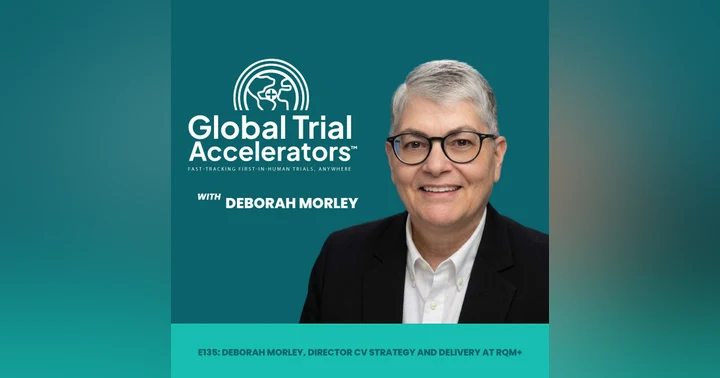
 Deborah Morley, Director CV Strategy and Delivery at RQM+
In this episode, we speak with Deborah Morley, an experienced leader in cardiovascular innovation, clinical research, and medical device development. Her career spans academia and industry, with extensive expertise in regulatory strategy and Class III implantable cardiovascular devices, including LVADs and cardiac contractility modulation systems. She currently serves as Director, Cardiovascular Strategy and Delivery and Co-Leader of the Cardiovascular Center of Excellence at RQM+.
Jesus Moreno (00:01.218)
Welcome back to Global Trials Accelerators, the podcast where we dismantle the barriers to clinical innovation and explore the strategies driving the next generation of life-saving therapies. Here is the stark reality facing cardiovascular care today. While fewer patients are dying of acute heart attack compared to decades ago, cases of advanced chronical heart failure are surging.
The sickest among these patients really rely on high complex class III devices such as implantable blood pumps, mechanical circulators, and cardiac contractility modulation systems. Given the risk and technical challenges involved in developing these technologies.
The transition from first in human study into everyday clinical adoption is arguably one of the most demanding journeys in all of MedTech. My guest today has walked through that journey from both sides of the table. Doctor Deborah Morley began her career as a cardiovascular physiologist studying failing heart mechanisms in the lab and teaching medicine and pharmacologies.
Deborah Morley, PhD (01:59.329)
Okay.
Jesus Moreno (02:01.14)
She then transitioned into the industry spending decades leading clinical, regulatory and quality operations from class three cardiovascular devices, taking complex systems through IDA, taking complex systems through IDE, PMA, CMARC, and into the real world.
Today she serves as Director of Cardiovascular Strategy Delivery and Co leader of the Cardiovascular Center for Excellence at Global CRO RQM Plus. doctor Marley, welcome to the Global Trial Accelerator Show. It's a real privilege to have you with us.
Deborah Morley, PhD (02:44.609)
you. I look forward to our conversation.
Jesus Moreno (02:49.856)
Dr. Morley, I would like to start at the beginning. Back in the lab, you started as a cardiovascular physiologist doing grandfounded research and slowly studying the intricacies of heart failure. What was it about?
The physiology of failing hearts that captured your attention and kept your entire career dedicated to this particular space.
Deborah Morley, PhD (03:25.665)
That's a great question. I I think there were several aspects of heart failure that attracted me to to study this area. one is that
Early in my career, I was working with a cardiology group, and many of the patients that we saw were younger. They had cardiomyopathies, some with the run-of-the-mill, ischemic heart disease, and coronary artery disease, but many had disease of the heart muscle, the myocardium that
Couldn't be explained, or that was a result of things like viral insults, alcoholic cardiomyopathy, peripardum cardiomyopathies. So I saw a lot of young people really, really suffering and became very intrigued because of my physiology background in how.
the heart muscle responded to these various insults, but but more how we could use initially it was primarily medications, but devices to alter that physiology
and and see improvement in these patients. The the devices, you know, initially were very large. They were like you know left ventricular assist devices and they they really just were replacing the pump action. But in 2026 those devices have come a long way.
Deborah Morley, PhD (05:28.331)
The ventricular assist devices that are available are much smaller with fewer complications. And now we have devices to really give the clinician a picture of what the physiology is. And so we're able to impact not only
the patient's clinical status, but really how they feel, their quality of life, and what what they're able to do. So so in short, it was studying the ultimate pump, the heart.
And that's really how I got into you know my expertise in ventricular assist devices and mechanical circulatory support because you know my my love, my what I really enjoyed studying was the physiology of the heart. And a blood pump really has to be designed in a way that it either complements or mimics that action.
And that's a real challenge. And finally, you know, I've really loved heart failure because you can see such an improvement in patients with the device therapies that you provide. I remember, you know.
Distinctly a a patient we had in a study that I was doing in Switzerland and it was a young man, eighteen, nineteen years old, who had idiopathic
Deborah Morley, PhD (07:09.069)
Cardiomyo dilated cardiomyopathy was really end staged, really was not going to survive. And we were able to implant this device that we had been working on for several years and trying to refine. And, you know, six, seven days later, the young man was up in bed and asking for a Coke.
And so it it really it really makes a difference and that's what it's all about for me.
Jesus Moreno (07:43.419)
the potential behind the therapy. That's that's wonderful, Doctor. And speaking of of that potential, you had a thriving academic foundation teaching medicine, running research programs, and then you made a jump that many academics contemplate, but few actually pull off. Stepping directly into industry. What was that cat catalyst that made you walk away from the academic
Deborah Morley, PhD (07:46.153)
Exactly.
Jesus Moreno (08:12.396)
faculty purely and and then step into the corporate regulatory and clinical domain.
Deborah Morley, PhD (08:21.869)
I think it's something that most young scientists face, and that's the availability of funding. At you know, the academic institution that I was at, I was teaching and I was doing research, but teaching doesn't provide revenue for the institution.
And I had NIH grants, but when that funding ran out, getting additional grant funding at the time was very, very difficult. And the institution was honest with me, they they could not continue to support a role for pure research and teaching without significant out external funding. So
Right about that time, we had started a LBAD study. This was very early in the days of LBAD studies, and I was the coordinator for the study, the clinical coordinator for the study at our university, at our medical school.
The company reached out to me and said, you know, how would you like to come and be our senior clinical scientist, manage our PMA submission and our clinical programs? And
Made sense to me at the time. So I jumped in. I was very, very fortunate to have a mentor at the company that could help me make the transition from you know academics to industry. I think it's a really hard transition for most people. And and actually I think you see this
Deborah Morley, PhD (10:25.321)
In the medical device industry, where you have number a number of founders and new CEOs who come from academics and really fail to thrive in the environment, largely because I think they are looking at the studies and what needs to be done from a purely scientific perspective.
When you transition to industry, the sciences is important, it's very important, but just as important are the business goals.
and what you can realistically do with the resources that you have, and what you have to execute in certain time frames in order to continue to get investors, attract investors and get funding, you know, for your company, particularly in the startup environment, which is where I specialize.
this is true. And I've s I've seen a lot of of companies fail because they have very wonderfully designed studies, you know, scientifically solid and really
would make a New England Journal of Medicine paper, but they aren't gonna make it in industry where the deliverables are
Deborah Morley, PhD (12:02.217)
now where the deliverables are on a time frame. In academics you could always say, well, you know, I I'm gonna take a sabbatical or, you know, so-and-so's on vacation, so we're not gonna get it done. That doesn't fly in business. You have to find a solution and make it happen.
Jesus Moreno (12:22.85)
That was gonna be my my question, Doctor. Like in that transition, if there were any habits or or lessons that you had to unlearn quickly as you as you move into the corporate world of class three devices, but i I I believe you've you've answered that question. anything you would like to add to someone that's contemplating to do that that shift in their career?
Deborah Morley, PhD (12:52.077)
I think the thing that I would add is that it's absolutely a great move because, particularly getting in the startup environment, because it allows you to use all of your scientific knowledge in so many different ways. Designing studies, working with engineers to help them understand how.
The patient response because a lot of the engineers have never seen a patient and they don't know that you know this little tweak in the device is gonna result in shutting down the the circulation at a patient. So being able to provide that and then learning.
Landscape learning that how to define goals and meet timelines all are adjustments that you have to make, but it's absolutely worth it in the end because so much more, I think, than in academics, you you see the results of your work, you see things come to fruition.
much more clearly. You're there when the device goes in the patients. It's it's not a research grant that you contributed to and and you know defined what the properties of such and such were. It's you
were part of building that device and you were part of deciding what patient population was best for that device and you were part of selling it to physicians and you were there when it was implanted and you can't beat that.
Jesus Moreno (14:46.579)
Very exciting. Thank you, Doctor. And speaking of that involvement, your career is is particular in that sense. Most careers in industry drift from smaller, less established companies to bigger ones, ones that are more established.
bigger organizations. Your your path ran inverse to that. You started in the big corporate program and then migrated towards the startup, working on progressively smaller, earlier stage blood pumps. What did operating on that agile, cash sensitive startup edge teach you that the big corporate MedTech simply couldn't?
Deborah Morley, PhD (15:39.458)
With the with the big corporate med tech, the your role was first of all more isolated. So you had a specific function and you did that function, but when it all came together, you weren't necessarily as involved. And in in the same way, the impact of
funding and resource allocation was a couple of levels away from you. So you you didn't feel that so much. But getting into the startups, particularly in the way that I joined, where I was the second or third employee in the company
You were there from the very beginning. So while you were hired to do clinical and regulatory, you were there at the beginning before those programs were started. So you had a role in the concept. You had a role in how design was going to occur.
You played a role in preclinical testing. You went from there to get regulatory approvals and for first in human and design first in human studies and make decisions about.
at what point a device is ready for first inhuman. That's a a very difficult and and important decision. And you played a part in that. And then you were there when the device went in the first patient.
Deborah Morley, PhD (17:28.269)
And you saw the company grow, you were part of that. You developed a full blown regulatory and and clinical team, you designed the studies, you defended it to the regulatory authorities. you were responsible for reporting all of the adverse events and the vigilance, and so you saw the problems and and you had to come up with solutions, or the company, you know, just went away. So
So you had that, and you also had it's pressure, but it's also good pressure from your you know CEO and your investors and your board to show results.
As a scientist originally, you had to walk the fine line between ensuring that one, the science was respected, that the regulations weren't violated, you know, you're not gonna let a company, you know, regardless of how excited the investors are, do something that is not allowed.
Or unsafe to patients that you're just not gonna let happen. And you know, you you have to think of how you're gonna put this all together in the end to drive adoption because regulatory approval is not enough.
that's really only the beginning of the story. And you have to be able to bring it to the end. And in my role as clinical and regulatory, and with my scientific background, a lot of what I was called upon to do was to.
Deborah Morley, PhD (19:29.565)
represent you know the clinical credibility of the company and the device and the studies and the the patients. And I I think that's that's very, very important. But I always had to be and was cognizant of how that played out in the boardroom.
Jesus Moreno (19:56.107)
So that sense of ownership and involvement and and being being part of the decision making process was what what it's what I'm I'm listening you explain and and how that has a impact and in the whole spread of the endeavor. and speaking of that
About the unique reality of the class 3 implantable devices. there are there are life-sustaining and therefore high risk technologies where the evidence bar is immense. For the developers listening who may be transitioning from a low-risk device, what makes class three cardiovascular pathway a fundamentally different pathway rather than just a
quote unquote harder version of class two. Can you help us understand that a little bit deeper, please?
Deborah Morley, PhD (20:59.831)
Sure, that's a that's a good question. I I think the first clarification that I want to make is that class three doesn't mean that it's life sustaining. Not all class three devices are life sustaining. Many are, like ventricular assist devices, respiratory support devices,
liver perfusion devices are are life-sustaining. But class three is really just about the risk. So they're high risk. And I think the transition that people have difficulty understanding when coming from say a class two device to a class three device is the level of evidence that's required.
The requirements are the same. You still have to show in the EU safety and performance, in the US safety and effectiveness. But the degree of evidence that you have to show is different. The bar is higher, obviously, for class three devices.
So you have to factor in the additional time that it might take to do the bench preclinical studies that are required. You have to factor in the fat you have to factor in your design, first of all, things that are going to be absolutely critical, like having a a fail-safe system. So if you have a pump.
that might fail, then perhaps you need a hand crank or something that's that's gonna allow it to to function. And if you don't have that kind of stuff, the regulators are gonna say, hey, it's you're not ready to go in humans. Another example is alarm systems. Many device manufacturers forget about things like that, but when you're talking about a high-risk device,
Deborah Morley, PhD (23:18.571)
Those kinds of systems are not optional. It's not something that you can say, that's a nice to have, and we'll design it in and include it in a second iteration of the device. You can't do that with the higher-risk class three devices. At the get-go, you have to have some form of those kinds of you know safety measures incorporated into the device.
And you've got to be able to show the regulators that they actually work when you say they will work. I think one thing that is often forgotten in you know, kind of s a a small segue here is human factors and usability testing that's required for any medical device, but particularly for class three devices.
and part of that is showing that you have an alarm or a fail-safe system, and that when it's activated, the people who are going to use the device actually can know from whatever information they get what it is they're supposed to do to take care of the patient. I'm not sure that everyone developing a device thinks.
through that far and to that granularity that you really have to do with the class three devices, particularly when they're implantable.
Jesus Moreno (25:02.208)
That's very insightful doctor, thank you. And in in the process of guiding that platform from the very beginning, the full life cycle of the device or or the bringing the device to market from IDE, PMA, the C mark, and even post market.
Looking across all that chain, all those steps in the process, where do programs most frequently break down? Is it a flaw in the core science or is it friction at the seams between each one of those stages? Or perhaps the regulatory strategy, or even maybe the the real-world commercialization of the of the device, where do you see the the process breaking down most often?
Deborah Morley, PhD (25:58.1)
Interestingly, I see and and my colleagues we see the process breaking down most frequently at the very beginning, before they get to IDE, before they get to PMA, before they get to C U Mark. And the issues are first of all knowing what your device can do, not dreaming what your device can do, but
actually building a device and knowing what its functions and what its its performance is. You know, I have we have lots of people come to us and say we have a device and it's gonna be able to do this and this or it can do this, this, and this. And you know, my first question is can you build the device? That's that's not a given.
And then where issues come up is defining what
They want in terms of target patients. Selecting a patient population that makes sense with what your device can do, one, but perhaps more importantly, is something that adds to you know medical care today, something that can be adopted.
You can go through and develop a device that checks all of the lists and you it's safe enough, you can get an IDE and you can do a pivotal study and get all of the data and demonstrate that it's safe and effective in a specific patient population. But if it's not a patient population where there's a clinical need.
Deborah Morley, PhD (28:04.373)
Or it's not it doesn't do something that physicians think they need in their repertoire or they need to better treat their patients, then it's not going to get adopted, let alone reimbursed. And you know, you can have the coolest device in the world, and without
Clinician and physician adoption and reimbursement, your company's gonna die. Your diour device is gonna die, it's going nowhere. And you really have to think about those things and plan for those things at the very beginning. If you're starting those conversations and you're starting to think about that when you get to the IDE.
God forbid the the PMA, you're way too late.
Jesus Moreno (29:06.114)
That brings us to the major theme of your work from my perspective, which is designed for clinical adoption. A startup can clear PMA, get the press release, and still fail commercially because physicians don't adopt the device or payers won't reimburse it, as you just alluded to.
What do you think are the hurdles that lived past that regulatory approval stage that actually dictate whether a cardiovascular innovation succeeds in clinic? Is there any specifics that you could point towards?
Deborah Morley, PhD (29:49.55)
I think it comes back to what I was alluding to, and that's you have to get key physicians involved at the beginning. So when you're designing your device, when you're talking about what population you're gonna study in your IDE trial or your pivotal trial, if you're not consulting
Physicians who know what's going on in the field, who are treating patients as part of it, then you're losing out because you're not going to see where clinical adoption is really going to take off later on. I think the second thing that happens very often is IDE trials are.
Design without thinking about reimbursement.
It's it's well known that FDA and CMS have different evidence requirements. And if you don't design your study to address both of those evidence requirements, you get to the PMA and you may have satisfied FDA, but CMS comes back and says, you know, you need to do this or we need to see
more clinical data. Excuse me.
Deborah Morley, PhD (31:33.076)
So I think that's really the take-home message is you've got to involve physicians, you've got to design studies with reimbursement and safety and effectiveness in mind. You've got to design for FDA and CMS. And I I wanna put a plug in. I think it's critically important in the US.
That founders and device companies take advantage of the pre-submission process that FDA has. It makes a hundred percent sense to talk to FDA about your plans, what you plan to test.
What patients you plan to study before you jump into the study. People worry about whether or not they're going to lose time by doing a pre-submission. My philosophy is you lose a lot more time when you get to the PMA, and FDA says you didn't do it right.
So taking advantage of the pre-submission process, I think, is is critically important. In Europe, there are now beginning to be ways that you can have consultations with expert panels, where you can have more interaction with notified bodies. So they're they're coming.
The other thing that I think is very important and that is helpful to people in the US is the early feasibility study process. That can be very helpful. And there's a push now, an initiative where they are trying to bring that type of structure to the European arena.
Deborah Morley, PhD (33:47.106)
So I think all of those things i i it's a it's a continuum process. It's not something that you either can do in parts or that you can say, well, I'll think about how clinicians are gonna use this later on. It's something that that you start in the beginning.
Jesus Moreno (33:47.394)
Yeah.
Deborah Morley, PhD (34:14.965)
And it's a dynamic process because as you learn more about the device, as you do more patients and learn how it's used, you refine the device, you refine the patient population, you learn from the clinicians. So it's a dynamic process, but I think the biggest thing I see in sponsors is not looking at the big picture.
and how everything fits together. Rather they silo on different parts and say, Man, I got the ID IDE, we're ready to go. I mean, we're this is success and everything's gonna be beautiful. You could do a study and have the totally wrong population or or you know collect data that's useless to CMS and you know you have a problem.
Jesus Moreno (35:11.81)
Yes indeed. I I wanna go down on a tand tangent, take advantage of of your comments about the EU. but and then we'll be back to the to the to the conversation we're having b which is very, very engaging for me. but given how dramatically the EU MDR has altered the European regulatory climate
How has the US versus outside US first in human decision change in the cardiovascular space for founders that are engaged in in that early stage of development? Have you seen a shift in their perspective about doing inside the US versus outside?
Deborah Morley, PhD (36:06.571)
Yes. When I first started in medical devices many years ago, it was a given fact that you didn't do first in man in the US. I mean the regulatory hurdles were just too great. So you did first in human in Europe usually. That was where you could get your ethics committee approvals faster.
It's shifted over the years. I think first going to Eastern Europe or Latin America, South America. And I think now the shift is back toward the US because of the EFS process.
Getting an IDE for an EFS is not getting approval for a pivotal study. FDA understands that the device may undergo iteration after the EFS. They understand that.
The specific patient population you test in the EFS may change when you get into the pivotal. And I at least in the experiences and the interactions that I've had with FDA, it's it's been a process that's been valuable because it has been a back and forth. And I think the
you know, the onus and the stress of dur doing first in human in the US has don't wanna say it's it's reduced because you still have the same evidence requirements, but
Deborah Morley, PhD (38:07.681)
The ability to study your device and the ability to get approval to do an EFS or first in human is is now, I think, harder in the EU with the NDR than it is in the US. And I think this is evidence. I was recently at New York Bows, and you saw that.
For example, in the tricuspid space, where there's a plethora of new devices coming out. And there was an entire session on the design of EFS studies for the various new technologies. So it has shifted. And I think that you know, my advice to colleagues now.
Is to consider US EFS studies in in your discussions with your investors and your board and your team. some companies still feel like going to Eastern Europe is easier. it it it may be going to South America and Latin America may be easier, but my concerns there revolve around
ensuring that the standard of care is the same. Because if the standard of care is not similar to the US and you can't prove that, then FDA is going to resist accepting that data. Theoretically, they do accept OUS data in support of a PMA, but
not 100% OUS data and not data that you can't prove was collected where patients received the same medical care as they received in the United States.
Jesus Moreno (40:21.244)
Excellent. Thank you for for clarifying that, Doctor. and speaking of of your engagement with with partners and and colleagues, you lead the cardiovascular strategy and delivery as part of your integrated life cycle model that unifies regulatory clinical quality reimbursement and even the laboratory services. What does
strategy and delivery actually mean in the day to day for companies you work with.
Deborah Morley, PhD (40:58.167)
So at RQM Plus, I'm the director of Cardiovascular Strategy and Delivery and the co-leader of the Cardiovascular Center of Excellence. The Cardiovascular Center of Excellence is new at RQM Plus. I lead it with Dr. Jayshankarkati. and what
our goal is and and this is really part and parcel of what my role is as as the strategy person and that's that we can offer our clients a full package
Going from initial clinical and regulatory strategy to you know, the entire pre-submission process or first in human in either the US or Europe. We have boots on the ground in Europe, we have boots on the ground in Latin America, South America.
We can take them from those initial studies through to the pivotal, the final, the CE marking studies. We can provide reimbursement. As you said, we also have Jordi Labs that we can provide biocompatibility. And one very exciting aspect of the CV Center of Excellence that we are currently developing is the ability to play.
Role in preclinical studies. We know that with cardiovascular devices, bench and in vivo studies are critically important. So we are in the process of partnering, for example, with the GLP laboratory, with a laboratory that studies valves, with a laboratory that studies pumps, to be able to provide our
Deborah Morley, PhD (43:00.755)
clients with a connection to these partners where they can do studies and we will still play a role and in project management and designing the preclinical studies is part of my my career saying that I've done A to Z in startups. I was always responsible for designing
the animal studies for designing the sterilization validation for doing the biocompatibility. So we can provide that entire package to our clients.
Jesus Moreno (43:46.647)
That's that's wonderful. A wonderful product, a well rounded product that yeah, takes them from end to end. I'm I'm interested in in learning more about that collaboration with with labs that focused on not necessarily the medical side of the device, but rather the mechanical. How how did that come about and and what can you share about that that strategy?
Deborah Morley, PhD (44:17.183)
It came about because Jay and I, who's my partner, were looking at what we could offer with the Cardiovascular Center of Escalence. And what we saw was that very often we would have clients that would come and we would be able to, you know, develop the the clinical and regulatory strategy for them. And
We would get that put in place. But before they could really take the next step, they had to finish, you know, building the device and and testing the device and knowing the device worked. So, you know, they would go off and do that and we would sort of lose connection until they came back and were ready to actually do first in human and we could get ethics committee and competent authority approvals and you know site setup sites, et cetera.
And we wanted to fill that gap. We wanted to be able to maintain a connection with our clients through that time period. So just from you know connections that that both of us have had in the past.
We reached out to some groups and talked to them about what our goals were and and how we could have mutual interests where we might bring clients to the partner and the partner might have clients that are coming to them saying, you know, hey, you're you're doing this testing for us and here's the testing report.
But we don't really know how we're supposed to go to FDA or we we don't really know how we're supposed to do this. So the partner could also bring clients to us. It's important that the partnerships are two-way.
Deborah Morley, PhD (46:05.867)
But that's how it came about, to fill a gap that we saw in our own services. Because as I said, the real goal of the Cardiovascular Center of Excellences is really to be the go-to CRO for cardiovascular devices. And the only way we can do that is to be full service in the true sense of the word.
Jesus Moreno (46:32.832)
That makes total sense. Total sense, Doctor. Thank you. And speaking of of becoming or or encompassing that that go to mentality, looking ahead over the next few years in cardiovascular innovation, what do you see i as the central how do you see the the center of excellence becoming
a leader in the industry. What is the core impact you want to achieve for the industry, for sponsors and ultimately for patients who whose lives more often than not depend on on those devices reaching reaching the market?
Deborah Morley, PhD (47:24.757)
Yeah.
Guess the way that I would say it is we want to be able to bring new and innovative technologies not just to regulatory approval but to clinical adoption. And we're doing that by having the full service, we're doing that by
offering reimbursement services. We're doing that by offering some preclinical relationships. We're also looking at putting together an advisory board of physicians for the Cardiovascular Center of Excellence.
So we're looking at bringing in that role that I talked about earlier where the physician input is important to clinical adoption, it's important to designing studies, it's important to designing devices. And we want to be able to have that overarching source or resource for the cardiovascular center of excellence.
I think that to really stay with what's happening in 2026, that you're see you're seeing a big change in cardiovascular devices. I think, you know, originally we were making devices and we were doing things like replacing the heart. So anatomically we were we were providing function, we were improving cardiac output. But
Deborah Morley, PhD (49:14.579)
What we're really seeing now are devices that are modifying physiology that aren't necessarily life sustaining but are improving function. So they're more focused on patients feeling better.
And in turn, then study designs are becoming more patient-centric. And that's part of what the Center of Excellence is prepared to help our clients do, is develop more patient-reported outcomes.
as important endpoints of studies, not just exploratory. So we're we're looking at study designs that revolve around how the patient feels not just is the patient alive after you use the device. And that's critical not just to the patient but to you know third-party payers to CMS to to everyone and I think that's the direction that
studies are going down. There's also a huge amount of technology coming out in terms of the mechanics by which we can study devices or by which we can study cardiovascular physiology in our patients. So the onset of remote sensors, the onset of wearable devices, all of those things bring new challenges
in terms of study design and particularly in terms of data collection. I was working with one group that had this really cool remote sensor that could measure you know all of these things and the data files were you know miles and miles long but I you know what do you do with all that data and
Deborah Morley, PhD (51:22.983)
Is there a workflow at the clinic that can manage that? You know, it's one thing to have a device that can have 900 alarms and tell you all these cool things, but if you have a nurse coordinator at the site who has to deal with 500 patients and 900 alarms, well, you can see how that doesn't work. And developing devices without understanding that.
or designing studies where you're collecting that kind of data is is not useful because in the end what you could put on your label what you can claim about your device is only what you studied and proven in your trial and so your trial has to be appropriately designed.
I think the other issue is AI. There's a lot of really interesting stuff happening in AI. So ECGs now, you can look at an ECG now and tell if a patient has amyloidosis or is gonna have a heart attack. That's wonderful. But the challenge is what's the actionable data?
You know, I okay, so I know that the ECG indicates that there's a good probability, based on all these algorithms, that the patient has X. But what does that mean to me as a physician? You know, what do I do with that information? Is that is that mean that I need to start treating the patient, or does that mean I need to increase monitoring?
Those kinds of things have to be studied and established, otherwise, these new technologies are not going to last. If you can't get actionable information, then the technologies don't have as much value. And if you can't design clinical studies that allow you to demonstrate.
Deborah Morley, PhD (53:44.939)
what the actionable information is, actionable information is, and that that does provide patients with better care, then you also haven't really succeeded. And the the expertise and the group that we're building with the CB Center of Excellence, that's what we're all about. That's what we're doing. We're we want to bring
Cardiovascular device studies into twenty twenty six and the new millennium, the new era.
Jesus Moreno (54:25.438)
Dr. Deborah Al Morley, thank you so much for sharing this with us today. My biggest takeaway from our conversation has to be how you reframe the the sign for adoption from s from day one. How that's not an option. It's it's a core mission in in this process of bringing new technology to to the market.
Thank you for sharing your experience, your insights, your strategies with us today. And to our listeners, if you found this episode interesting and it provided value to you, would you please consider subscribing and sharing it with one of your colleagues that is perhaps leading efforts to build the next generation of cardiovascular breakthroughs?
Doctor Morley, thank you for being with us.
Deborah Morley, PhD (55:24.865)
Thank you for having me, it was a pleasure.
Jesus Moreno (55:28.818)
And until next time, keep accelerating.