Apple Podcasts

 Spotify

 YouTube
 RSS Feed
Paulo Fernandes, C2O Fundador & Principal
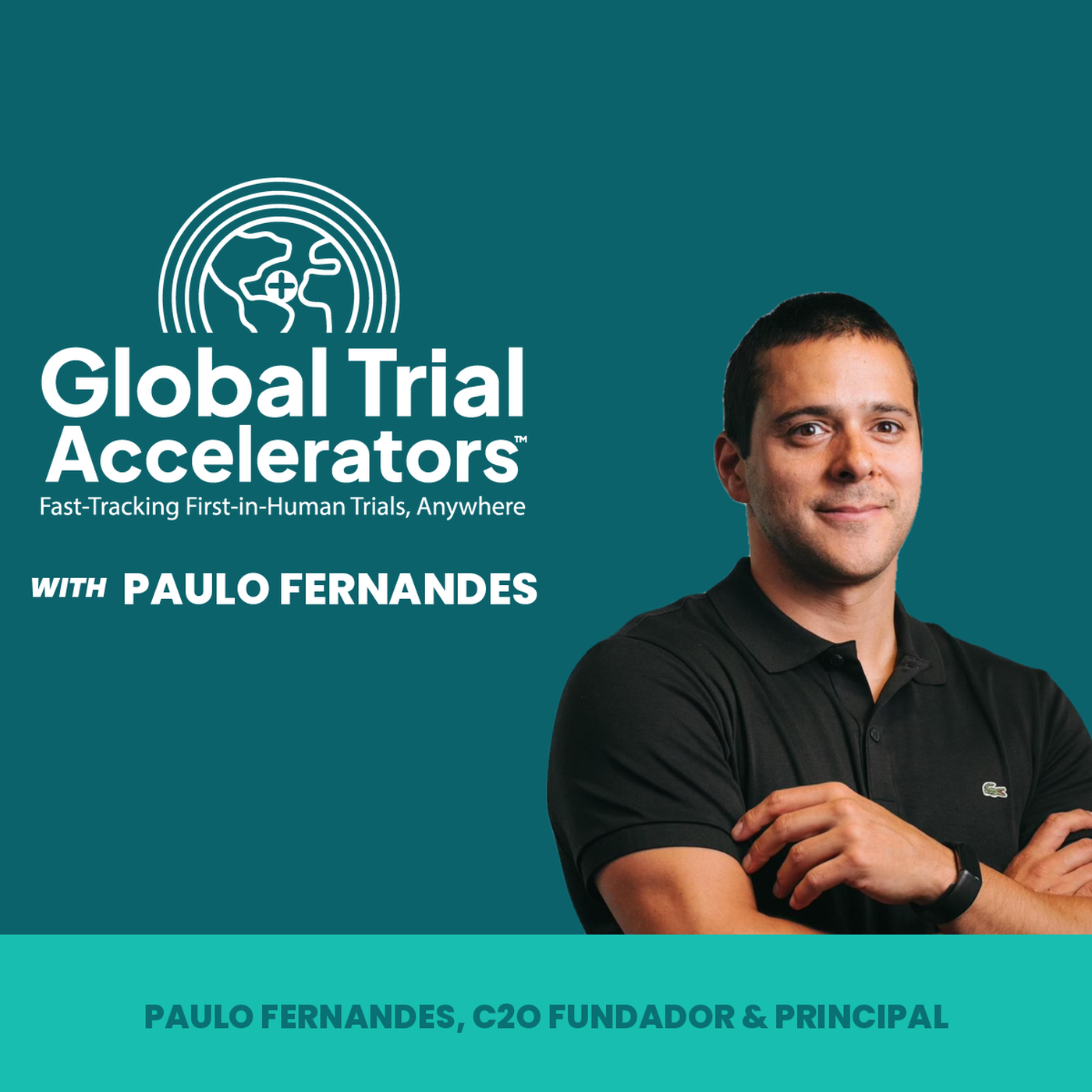
Paulo Fernandes is a distinguished clinical research executive with extensive experience in international clinical trials across various phases and therapeutic areas. With a solid foundation in the CRO industry, he has successfully held roles in project management, start-up, operations management, and business development. Paulo has worked at renowned CROs such as PPD, Covance, and IQVIA. Recently, he structured a healthcare sector start-up for a group of investors, showcasing his entrepreneurial spirit and commitment to high-impact public health initiatives. Additionally, he has 10 years of experience at the Brazilian Association of Clinical Research Organizations, including 4 years as the President of the Board of Directors. Paulo holds a specialization in Clinical Pharmacology from USCS, a degree in Pharmacy and Biochemistry from FCF-USP, and training in Business and Project Management from FIA, along with an Executive MBA from INSPER.
Julio G. Martinez-Clark: Welcome to the Latin MedTech Leaders podcast. A conversation with leaders who have succeeded or plan to succeed in Latin America. Please subscribe on your favorite podcasting platform, Apple Podcasts, Spotify, Amazon Music, etc. Today our guest is Paulo Fernandes, a Brazilian clinical research executive with experience in international clinical trials in various phases and therapeutic areas. Paulo, I'm very delighted to have you here. I look forward to our conversation.
Paulo Fernandes: Alright, thank you for the invitation. It's going to be a pleasure to have this talk.
Julio G. Martinez-Clark: Excellent. Paulo, alright.
Julio G. Martinez-Clark: Paulo, let's get started with your journey to the clinical trial world. How is it that you got involved in this industry?
Paulo Fernandes: Okay, that's a very interesting question at least. I think it allows for sharing a little bit more on what are the pathways for professionals from Latin America to join the field, right? So I started working for a CRO nearly 20 years ago. And at that time, the main pathway for getting started was as a research assistant and then as a CRA. So I had a good opportunity to be working on the field for seven years monitoring clinical trials, visiting investigators, talking directly to site staff, which I just feel it was a very good opportunity and actually helped me to prepare to take over management in working with the clients on coordinating clinical trials in the region.
Julio G. Martinez-Clark: Excellent. You've had an outstanding career based on your resume. You work for PPD, Covance, IQVIA. I mean, that's extraordinary to be involved with international CROs like that. And also you gain a lot of training, corporate training, which is fantastic and a worldview of clinical research, right?
Paulo Fernandes: Yes, that's for sure. I mean, you mentioned that these three companies very, and they had very good experiences there, right? In terms of corporate training, the drive for quality is execution, the contact with the investigators. So all of these three companies take it and took it, all of these very seriously. And there were like a lot of support to the staff. I can tell you, I had the opportunity to have very good mentors throughout my career, people who really helped me to understand the industry and also the importance of working very closely to sites.
But yeah, definitely very good training, very quality oriented, which I just feel supported and continue to support the good track record our region has in the clinical trial landscape, right? Latin America is a very good region for placing clinical trials. And we face a strong track record of delivering to really big and important trials globally.
Julio G. Martinez-Clark: Excellent. Okay, so my second question is about trends. What trends do you see happening in Latin America and or Brazil that are making Latin America a great place to do clinical trials right now? Political trends, economic trends, social trends, disease trends, what do you see happening now?
Paulo Fernandes: Well, another very good question is it gives the opportunity to share a little bit more about how seriously a good part of our countries are taking clinical trials in the past few years, right? So we are a good region with good and a strong record of delivery in global trials. But what we have been able to see in the in the latest few years is the enhancement on the on the practice from the regulators, right? And this not only in terms of the quality of the assessments, we have, for example, in Brazil, a very strong regulatory authority, which is called ANVISA, and which is an ICH member with very well known for the quality of the assessments they conduct. And this was really exposed during COVID-19, right? As Brazil had the opportunity to take part on the development of global products. But we also have like ANMAT in Argentina following the same path being a member of ICH. And the regulatory reform in Argentina, which led to more competitive timelines for the assessment of clinical trials.
The trend followed by Brazil this year with the clinical research law, the new clinical research law, which in the end of the day, is aimed to help the ecosystem to be more predictable, and also to improve the competitiveness of the timelines in Brazil. So I always like to say, Latin America is very strong as a whole, as a region, as you place your trial in several countries, and get access to a diverse population, but also to a right mix of investigators who are able to deliver to recruitment to the recruitment needed for the studies at good quality. And now, with more competitive timelines when we compare to other countries around the globe.
Julio G. Martinez-Clark: Yes. Well, let's get back to your background, because you're bringing up the issue of the new law in Brazil, and that's a topic that I really want to address in this episode. But you were the president of the board of directors of the Brazilian Association of Clinical Research Organizations, which is a big deal for somebody to lead such an organization in such an important country like Brazil. So you were, in that capacity, you were involved in helping the regulator and the government draft the law. Is that correct?
Paulo Fernandes: Yes. Well, definitely it was, at least for me, right, a big deal of something really important that definitely marked my career. I had the opportunity of working as a volunteer inside our local clinical research organization's association, which is called ABRACRO, and I spent 10 years there as a volunteer, right? So I started working on discussion groups, then coordinating a commission, got involved with the board of directors, and spent nearly four years leading the board of directors for the association, where I had the opportunity to get involved on the discussions about the new law. Of course, it wasn't something done only by me. It started with very good people who were actually visionaries in the past by creating an association to support the improvement of the ecosystem, right? So these guys, they definitely deserve the merit, and it ended up with allowing the association to get involved on the discussions, to discuss with regulators, with the government about the sector, the view of the sector, about what should be improved, the needs, the global trends, how to be competitive, keeping high ethical standards and the quality.
So it was really an amazing journey. And to get to a place where I had the opportunity to see the bill being approved, it was really amazing. We spent nearly 10 to 11 years working on that, not only at ABRACRO, but other associations, investigators, people really concerned about doing high quality research, but also about improving the level of opportunity for the population. Because at the end of the day, although it's not the primary objective, clinical research can also mean access to the population, right? Especially in a region where we have still a lot of disparities, social and economical disparity within the population. So yes, it was an amazing journey, like 11 years working for that and supporting it and representing the sector, right? Very big responsibility, which I mean, I'm really proud about the fact I had the chance of contributing, of adding two or three blocks to the wall.
Julio G. Martinez-Clark: Fantastic. Congratulations. I mean, that's an amazing accomplishment. Alright, so let's talk a little bit about the law, what new changes it brings to the ecosystem in Brazil. Brazil. How will it make Brazil a more competitive country for clinical trials? Because in my experience, and I come from the medical device clinical trial world, as you know, medical device companies, at least medical device startups, don't usually think about Brazil as a place to do first in human early feasibility proof of concept clinical trials. They go to other countries that are more friendly to these type of studies where you can get them started anywhere between 30 and 90 days, which is kind of the timeline that these companies are looking for. So is Brazil going to be now an innovator of these companies and also from a surgical companies that want faster approvals?
Paulo Fernandes: No doubt. I do think that's going to change. Brazil, the compelling offer that I like to to discuss and to show about Brazil relates to the ability to recruit fast and now in a more competitive timeline landscape. So the law itself may propose some changes to the total timelines for the regulatory authority evaluation. So now we are talking about nearly like 100 days, 120 days for this assessment. And also something that it was very characteristic about Brazil in the past relates to the fact we used to have two ethical approvals, one from a local ethics committee, another one from the national ethics committee. Now with the law, that's going to be one ethical approval. Local ethics committees will be able to assess and approve these studies, which we expect added to the new timelines for the regulatory authority to put ourselves in a the population aspect. And also the fact Brazil is a very relevant market in terms of selling of these products.
All of the three conditions will definitely put Brazil in the map for the medical companies. And for pharma, I mean, we have a very good track record with phase three trials, right? That's going to only get even better. Yeah, with better timelines, the population aspect, the fact that our people here, most of them live in cities, which make research more accessible for them. All of these together will support Brazil to become supporting already Brazil to become more competitive in the global ecosystem for clinical research, either for drugs, but also for devices.
Julio G. Martinez-Clark: Yes, yes. All right, so let me see if I understood correctly. So the first step is IRB or ethics committee approval. And that takes around what?
Paulo Fernandes: 90 days. 90 days.
Julio G. Martinez-Clark: I mean, is a private IRB inside the hospital or can also be a central IRB?
Paulo Fernandes: It's not private, but it's inside the hospital or associated to the to the institution proposing the research, which can be a private practice, right? But we used to have two approvals, the local IRB and the central. And now that's going to be just one.
Julio G. Martinez-Clark: Just one, the local IRB or ethics committee. Yeah. And that takes about 90 days.
Paulo Fernandes: Yes, that's going to take about 90 days. 90 days.
Julio G. Martinez-Clark: And then you have to go to ANVISA, the National Regulatory Agency, and they evaluate the study and take how much?
Paulo Fernandes: They will they will have the maximum of 120 days.
Julio G. Martinez-Clark: Maximum 120 days. So we're looking at 90 days, the local IRB or ethics committee, and then 120 day tops.
Paulo Fernandes: Yes, yes, we expect taking into account administrative stuff, contracts and the approvals to be able to activate sites with like, depending on the trial, four months, five months, something like that, there will be of course, [inaudible] very complex studies, which need more assessments, or which sure, which have more multiple rounds of assessments. But that's not the case, you know, it's gonna be really more competitive. We are talking about like 160 days to have sites activated. That's gonna be awesome.
Julio G. Martinez-Clark: Yes, yes. All right. Good, good. Excellent. Okay, so let's let's talk a little bit about the healthcare system in Brazil. Why is it good for clinical research? Let's talk about the public system, the private system. Are public hospitals friendly to clinical trials? I understand that I mean, a large percentage of the population is probably in the public system. Can we do trials there or not, or have to or we have to move those patients to private hospitals? How does it work?
Paulo Fernandes: That's very interesting to share. Brazil have 200 million to nearly 200 million people, right? 80% of these people is actually, they use the national healthcare system. 80% of the 200 million people are in the public healthcare system. In the public healthcare system. This is most probably one of the biggest and largest networks of public hospitals and primary care, ambulatory outpatient clinics that we can see around the you know, so this makes the access to medical care widespread all around the country with nearly with the majority of the population being able to enter in a public healthcare institution and get treated. So that's one of the most important things about the infrastructure in Brazil. And one of the things that makes it a very good place to recruit for large trials, you know, we can recruit population from north to south. And this is very like the network is already there is like a network by design.
Of course, each of the states institutions, they have their own rules. But the majority of the states in Brazil are served by institutions maintained by the federal government. And all of these are part of a network. And very often, these are also connected to the medical schools. That's where we see a lot of the research, good, a good volume of clinical research happening. So it's all there, you know, it's very, it's very interesting when we take a deeper look and see that we have 27 states in Brazil. And these medical schools is where very often research happening. The same investigators who are professors in the medical schools, they also very often treat patients in the private health care system, the other 20 million, 30 million people, either in hospitals or through their private practices. So these investigators, they have access to the entire to the to the entire population to the entire country population.
So this makes Brazil a very interesting location, because when we implement a trial, we can go for the patients where they are, you know, we can map using data, for example, from DATASUS, which is the electronic system kept by the federal government about health care. And we can we can identify incidents and prevalence of diseases and go in and try to maximize the the the performance, the possibility of allowing patients to get access to trials to clinical trials. So that's very interesting about our local health care infrastructure.
Julio G. Martinez-Clark: That's fantastic. Yes, I've heard about the DATASUS that you're referring to the United States, they call it a claims database. Colombia also has a very good one. And I heard about the Brazilian one, because it covers, as you said, 80% of the population. So you can do a lot of good epidemiology research on it and look at where patients are.
Paulo Fernandes: There are companies already taking advantage of it, and it's worth saying that all of these within the GDPR regulations, you know, no individualized patient data is accessed. So all of these focused on implementing the clinical trials where they are most needed and where actually participants can be found, which works for the good either of the participants, but also of the research, the purposes of the research, and also it helps the healthcare system. And then at the end of the day, when you are getting treated under a clinical trial, you are actually saving public resources, you know.
Julio G. Martinez-Clark: Absolutely. That's a good point. Now that you're talking about saving money, let's talk about cost. Is Brazil a cost-competitive country for clinical trials?
Paulo Fernandes: Definitely. No doubt. There are several factors which contribute to this view, but one of them relates to the fact we have very well-formed healthcare staff and a lot of people choosing careers such as [unclear: medicine], but not only. Like we have nurses, pharmacists, biomedical doctors, so we do have people with good academic level. Economics for the global development landscape very often are based on dollars, right? And we do have a very competitive and positive economic landscape for the execution of clinical trials here. The cost of healthcare in Brazil is still lower than the cost of healthcare in other places around the globe. One of the things is mainly related to the public healthcare system, you know. So the way it's structured, it also helps this cost relation.
Julio G. Martinez-Clark: Excellent. Paulo, I think this covers most of the topics that listeners want to learn about when choosing a destination for clinical trials, at least for medical device clinical trials. Is there anything you want to add to your discussion, to your comments?
Paulo Fernandes: Well, I always like to invite people who actually do not know Latin America or don't have detailed information about it to get in touch, to contact people like ourselves who can actually help them to navigate through the nuances of the region and also to reaffirm that this is a very good region for execution and also creation of clinical trials which can contribute to the global development landscape, you know. It's just a matter of ask the right questions and go to the people who can actually support things in each of the countries. We do have very good investigators and a very strong track record of delivery. So all of these is what I think it makes Latin America really, if not a new frontier, the next frontier for clinical development. A growing market of also local pharmaceutical companies is starting to propose innovations. So it's a very interesting and positive moment for Latin America as a region.
Julio G. Martinez-Clark: I totally agree. And to add to that comment, I think there is a movement of many governments in Latin America to, one, join ICH. Mexico, by the way, is also an ICH member. I think they joined us here. So now we have three countries, as far as I understand, there are members, which is a big deal for Latin America because it took us a while as a region to join that club. And also the fact that countries are issuing new laws for clinical trials. They are now aware of the fact that that brings a lot of benefit to the patients, to the healthcare system, cost savings and other things, innovation, et cetera, and also foreign investment, which is badly needed in our country. That brings jobs, high-paying jobs. So I applaud this new era, this new way of thinking of the Latin American government. Also Colombia is thinking about a new law. Panama has a law, Paraguay has a law, Mexico is making very, very good changes based on this new thinking. So Argentina did it in what, 2017, something like that. So yeah, things are looking great for Latin America.
Paulo Fernandes: So attract more clinical trials. Completely agree.
Julio G. Martinez-Clark: All right, Paulo, thank you so much. I appreciate your involvement with the Latin MedTech Leaders podcast. I look forward to our future conversations.
Paulo Fernandes: Thank you, Julio. Very good opportunity to be with you.