What Trial Teams Miss When Science and Operations Work Separately
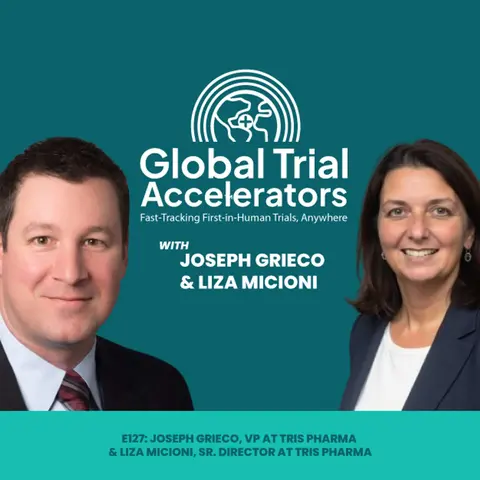
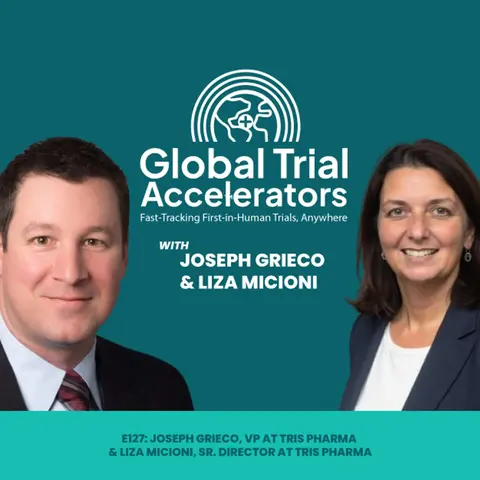
A useful clinical strategy is not just scientifically sound. It also has to survive contact with real patients, real sites, real timelines, and real failures. In their conversation with Jesús E. Moreno on Global Trial Accelerators, Joseph Grieco, then Vice President and Head of Clinical Development at Tris Pharma, and Liza Micioni, then Senior Director and Head of Clinical Operations, make that point from two sides of the same table: development strategy and clinical operations.
That pairing makes the episode worth hearing. Grieco talks about endpoint design, regulatory acceptance, and development pathways. Micioni talks about what happens when those plans meet the clinic. Together, they outline a practical way to think about trial design.
Protocol design should start before the protocol is written
One of the clearest lessons from the conversation is that operations should not be asked to rescue a protocol after it is finished. Micioni says she has been fortunate to work in settings where operations was involved early, because what looks elegant on paper may not be workable at a site. Grieco describes a similar process at Tris Pharma: scientists start with a synopsis, then bring in operations, regulatory, and other functions before the full protocol is built.
That sounds simple, but it changes the quality of decisions. A scientist may want more data, more endpoints, or another study arm. Operations sees the downstream effects: extra blood draws, site workflow conflicts, longer timelines, and higher cost. Those are not administrative details; they can affect deviations, data quality, and whether endpoints are measured the way the team intended.
As Grieco puts it, "It's really important to get a strong multifunctional input on your protocol designs very early before you even spend the money or the time and effort to build out the protocol in total."
For smaller companies, this kind of early review can mean fewer amendments and delays later.
Patient-centric design means fitting the study to the patient, not the reverse
Micioni returns to one principle again and again: "It's about the patients."
Her example is technology. Sponsors often want one clean system for everyone in a study, but patients do not arrive with the same habits, devices, or comfort level. She points out that an older population may not want to use an app, and some participants may do better with paper even if others can use electronic tools. Her point is not anti-technology. It is anti-rigidity.
That same logic applies to sites. Micioni says, "I think it's important to also meet sites where they are and not give everyone new technology that they then have to start over on every study that they do." That is a useful operational filter: if a tool adds burden without improving the outcome that matters, it may create more noise than value.
Grieco adds an important scientific caution. Digital tools, gait measures, eye tracking, and other objective methods may be attractive in CNS and rare disease work, but regulatory acceptance still depends on validation. In his experience, the FDA may accept those measures as supporting evidence while remaining cautious about using them as standalone proof. Better measurement can help, but only if the measure is accepted for the concept the trial is trying to prove.
The discussion gets even more practical when Grieco describes low questionnaire compliance in a Phase II study. One mitigation that helped was gamification within an app, which improved completion by making the task more engaging. His preference for bring-your-own-device follows the same logic: people are more likely to notice prompts on a phone they already use.
The best teams plan the pivot before anything goes wrong
Clinical operations is often described as problem solving, but the episode suggests a better standard: assume that something will fail and build the backup path in advance. That is how Micioni describes endpoint collection when technology breaks. Sites were prepared to capture the data on paper and move it into the electronic system later if needed.
That approach protects what matters most. Grieco says, "The primary endpoint is to be protected at all costs."
The examples they discuss are not theoretical. Micioni mentions the pandemic and the start of the war in Ukraine as reminders that trials operate inside real life, not outside it. Teams need trained partners, clear contingency paths, and the authority to adapt while preserving data collection.
Grieco’s view of operations is notable here. He does not describe operations as execution after strategy. He describes it as the function that sees risk first and can propose workable alternatives when the original plan no longer fits the moment.
Approval strategy should shape geography and development path
Another strong takeaway is that geography is not just a cost or speed decision. It starts with the approval plan. Grieco explains that if a company expects to file in the United States, some U.S. trial activity is a given, but other regulators may require different comparators, endpoints, or evidence based on how patients are treated in their regions. He gives the example of chronic pain, where the EMA and the FDA can expect different things.
Micioni makes the same point through feasibility. In one pediatric rare disease study, Europe accepted an active comparator while the United States wanted placebo control, and the study was run only in Europe because that design was more workable for the patient population. She also notes that timelines vary by more than ethics review alone; contracting and local site processes can erase apparent speed advantages.
The same approval-first thinking appears in Tris Pharma’s platform strategy. Grieco explains how the company has used LiquiXR and the 505(b)(2) pathway to reformulate already approved drugs, relying on existing safety and efficacy data while generating the studies needed to show bioequivalence. His example is a clonidine product developed for ADHD, based on a treatment gap he says the company identified through physicians and patients.
That is a practical lesson for founders: speed does not come only from moving faster. Sometimes it comes from choosing a path that reuses existing evidence, provided the product still solves a real patient need.
If you want the full discussion, including how Grieco and Micioni think about CRO relationships, investigator engagement, and backup planning, listen to the complete episode here: Joseph Grieco and Liza Micioni on Global Trial Accelerators.
About Global Trial Accelerators™
Global Trial Accelerators™ is the podcast for MedTech, Biopharma and Radiopharma founders navigating first-in-human clinical trials. It is hosted by Jesús E. Moreno and produced by bioaccess®, a CRO purpose-built for first-in-human trials across the Americas.

Host · Business Development Director, bioaccess®
Jesús E. Moreno is a business development director who provides efficient and reliable clinical research services across the Americas. With a passion for driving innovation in the healthcare sector, Jesús leverages his bilingual biomedical engineering background and his understanding of the unique challenges that Medtech startups face to provide valuable support and deliver accelerated clinical study results. Jesús profoundly understands the critical role that reliable and streamlined clinical research plays in the success of Medtech startups. He firmly believes that by offering cost-effective solutions without compromising quality, Medtech startups can achieve their clinical goals faster and make a meaningful impact in the healthcare industry. Jesús is passionate about supporting Medtech startups in their journey towards bringing innovative medical technologies to market. Jesús possesses the technical expertise to understand the complexities of medical devices and technologies. This knowledge enables him to identify tailored solutions that meet the specific needs of Medtech startups. Jesús has a bachelor's degree in biomedical engineering and a master's degree in electronics engineering.
Why Better Data Curation Can Shorten Biomedical R&D


 RSS Feed