Apple Podcasts
 Spotify
 YouTube
  RSS Feed
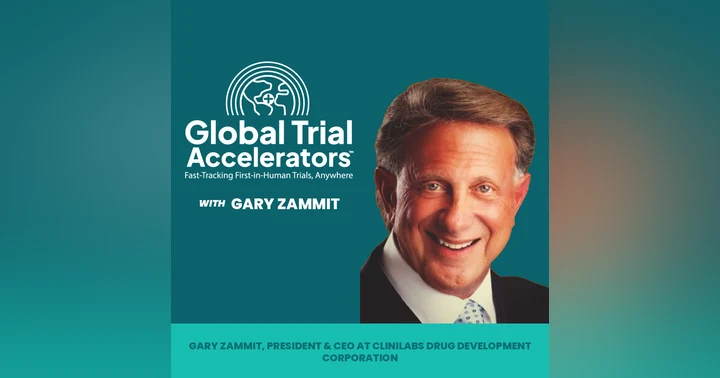
 Gary Zammit, President & CEO at Clinilabs Drug Development Corporation


In this episode, we welcome Gary K. Zammit, a leading expert at the intersection of science, business, and innovation in the life sciences industry.
Gary is the founder and CEO of Clinilabs, a CNS-focused contract research organization, and the author of Beyond the Science: How People, Process, and Systems Transform the Business of Life Sciences. He also serves as a clinical professor of psychiatry at the Icahn School of Medicine at Mount Sinai and is a fellow of the American Academy of Sleep Medicine.
With more than 250 published articles and abstracts, Gary has spent his career advancing safer and more effective treatments for psychiatric and neurological disorders. In this conversation, he shares insights from decades of experience—exploring how scientific rigor, operational excellence, and human-centered leadership come together to transform healthcare innovation.
Tune in for a deep dive into the future of clinical research, entrepreneurship in life sciences, and the systems that drive meaningful impact.
Global Trial Accelerators™ is produced by bioaccess®, a CRO built for first-in-human and early feasibility trials that can activate and deploy clinical research resources on demand across the Americas, Canada included. Explore first-in-human trials: bioaccessla.com/first-in-human-cro · LATAM market access: bioaccessla.com/market-access
Jesus Moreno (00:02.115)
Welcome back to Global Trials Accelerators, the podcast where we dismantle the barriers to clinical innovation and explore the strategies driving the next generation of life-saving therapies. Today, we're talking about the central nervous system or CNS for short. Specifically trials, one of the most complex and high-risk areas in drug development. The science is complex, the endpoints are often subjective,
Gary (00:09.03)
. .
Jesus Moreno (00:29.737)
and the path to commercialization is narrow. To survive a leader must look beyond the lab. And today's guest argues that overcoming this hurdles doesn't just take breakthrough science, it requires a complete rethink of how we run the business of clinical trials. Joining us today is Dr. Gary K. Samit. He is a clinical professor of psychiatry at the Icahn School of Medicine.
Gary (00:36.709)
you .
Jesus Moreno (00:58.057)
at Mount Senai. Let me try that again. He is clinical.
Gary (01:04.878)
Actually, actually I'll interrupt you there because. I I just retired from that position about. Two weeks ago, so so you've got you probably didn't have that so we can leave that part off if you like.
Jesus Moreno (01:10.028)
Yes.
Jesus Moreno (01:19.997)
Jesus Moreno (01:27.351)
Okay, he's a career clinical professional of psychiatry.
Gary (01:34.382)
Well, you could say I'm a former professor of clinical psychiatry at the Akron School of Medicine. Yeah.
Jesus Moreno (01:37.559)
Yeah, that sounds great. Thank you.
He is a former clinical professor of psychiatry at the Aiken School of Medicine at Mount Sinai. sorry, that word trips me up.
Gary (01:54.111)
It's us. Sorry, it's Sinai. Yeah.
Jesus Moreno (01:57.769)
Sinai, Sinai, thank you. He is a former clinical professor of psychiatry at the Icahn School of Medicine at Mount Sinai, as well as the founder and CEO of Cleanly Labs, a highly specialized CNS CRO, and the author of the new book, Beyond the Science, How People, Processes and Systems Transform the Business of Life Science.
Gary, it's an honor to have you here with us. Welcome to the show.
Gary (02:29.382)
Thank you, Jesus. I'm pleased to be here.
Jesus Moreno (02:32.961)
Gary, I would like to start by asking you about your career. On the clinical and academic side of things, what was that exact gap you saw in the industry of clinical trials that made you say, I need to step out of academia and build a CRO to fix this?
Gary (02:55.552)
Yeah, that's great question because from the outset of my career, I saw myself as an academic, as someone who would be involved in teaching and research throughout my professional life. I had never imagined that I would be embarking on starting a company and running a company in the clinical trials space. But before I started the company, I was working as
as the leader of a program at an academic medical center that was affiliated with Columbia University College of Physicians and Surgeons. And as part of my work, I was running clinical trials. And very often, I would work with CROs as part of that process.
CROs back at that time, this was now more than 26 years ago, but the CROs back at that time often struck me as not having the familiarity with the field that I was in, which was sleep medicine, that's where I originally trained. They just didn't have the familiarity with that space. And when I talked to project managers, monitors, and other people at those CROs, it really struck me that they didn't understand
the clinical protocols, they didn't understand the patient population, they were unfamiliar with the endpoints that were so critical to the outcomes of these studies. And it really struck me that it would be great if somebody would start an organization that understood the regulatory and operational aspects of running a trial.
as well as the scientific aspects of running a clinical trial. If you could marry all of those things together, maybe the CRO would be a cut above. And that thought was recurrent to me over the course of a year or two. And then finally it dawned on me that someone should do it and maybe that should be me. And so I took the challenge and decided that I would leave my
Gary (05:21.269)
position at the hospital and start a contract research organization just focused on CNS.
Jesus Moreno (05:32.376)
That really sets the stage for what you discussed in your book. And you argued that even the best science assets will fail if the underlying business operations are weak or not where they need to be. Could you share with us maybe an anecdote, an experience where you saw that firsthand, maybe a clinical trial and maybe paint us a picture of how that developed?
And if there were any signs of early signs of that being an issue that our audience could maybe take into account when they're planning their next trial.
Gary (06:16.029)
Sure. Very often in clinical trials, we tend to think that the heart of the project success is in the scientific protocol or the clinical trial protocol itself. That it's all about the protocol.
And while the protocol is certainly an important element of that, my book, Beyond the Science, really focuses on what is outside of the clinical trial protocol that's so important to making a project a success. It's really the triumvirate of people, processes, and systems that all come together to make any clinical trial or any clinical development program.
truly successful, truly not. And when we have teams that are functioning really efficiently with the right people, the right processes, and the technology accelerators, that's when we can really deliver outsized results for our customers, for sponsors, and ultimately for the patients that we're going to serve who will be taking the medication that is developed if it is so approved.
When I think back to specific instances, think back to one particular instance where a sponsor came to us and said, we have a new investigational drug. We want to test it and we want to test it using this specific protocol because this was the protocol that was used by another company.
who achieved success. And so we were given the protocol, the sponsor wanted to run the study exactly as it had been done before. But what they failed to recognize is that the patient population that they wanted to test was slightly different than the patient population that was tested in that first original study.
Gary (08:33.378)
And that would call for more sensitivity around the inclusion and exclusion criteria that would be used to select patients for participation. It would be also important to modify some of the processes, some of the procedures in that clinical trial and also
some of the key secondary endpoints. So the sponsors' insistence on doing things one way simply because it had been done that way before probably didn't serve that particular sponsor very, very well. That protocol really needed to be unique for the specific asset that that
sponsored wanted to test and for the specific patient population that that sponsor wanted to look at. it really took that combination of getting the right people on board who could think a little bit outside of the box, think differently, think creatively and innovate for their own protocol and then also apply the processes necessary to...
achieve results in that protocol, that's really what was needed.
Jesus Moreno (10:07.055)
That's a wonderful lesson to learn early on. And you alluded to the next question I want to post a little bit in your first answer. You talked about how one of the reasons why you stepped out from academia into the business world and the CRO specifically was that you saw that there was a misunderstanding from the
medical understanding of the pathologies involved in central nervous system studies. And I'm curious to explore that a little bit further. How does your background as a clinician change the way you advise biopharma CEOs and to those that can't afford the wealth of knowledge that you possess? What
What would you tell them? How can they better understand the clinical side of things to better design their trial?
Gary (11:14.779)
Yeah, great. It's a great question because.
Having experience as a clinician puts the researcher really in touch with the patient, with the person who will be ultimately using a medication if it's approved or a medical device if it's approved, and also with patients who might be participants in the clinical trials that are conducted to test a drug or device efficacy or safety.
So having the perspective of the clinician really puts you in touch at the ground level at what's going on. And it's really important that the patient's voice is heard and understood very early on as a project is being conceptualized, as a study is being designed, and also ongoing through the project if these patients are being.
enrolled as study subjects. And so I think the clinician's perspective can be really invaluable. And yes, it is true that there is kind of specific knowledge around the conduct of CNS clinical trials. CNS clinical trials tend to be more complex than other types of clinical trials in other therapeutic areas.
us, CNS clinical trials often involve softer endpoints. So we're for example, testing a weight loss drug and having somebody get on a scale and then we can measure their weight or testing a drug that might reduce tumor size and being able to excise a tumor and then weigh it or measure it.
Gary (13:14.504)
So specifically in CNS, we're often doing rating scales where a clinician asks patients how they feel and then rates those patients, whether it's depression or anxiety or stress or any number of things that might be important to the conduct of the trial. So the CNS trials are unique in their complexity, unique in their use of softer endpoints.
they often have higher failure rates. And we also have to deal with other things like placebo response in clinical trials and managing that placebo response is really important to getting the right outcome to a clinical trial. you say, some sponsors might not be able to afford that kind of expertise. I would argue that
they can't not afford that expertise. So if they don't have the expertise internal to their company, that's when they really need to think about bringing on board the best teams that they can assemble, whether they be advisors or CROs or other pharma services providers to help them or building their own internal team.
that's really important to lay the foundation for their future success. Getting all the right people on board, the right perspectives, the right opinions, and really doing the best they can early on to set the stage for success.
Jesus Moreno (15:01.608)
That's excellent. People, processes, and systems. I think that's a succinct way of summing that up. And this answer you just gave us, it's a perfect segue to the next topic I want to explore with you. it's around that notoriously difficult nature of CNS trials. As you mentioned, there's a high rate of placebo response.
and subjective data reporting. I'm curious to learn what are the most practical ways sponsors are using new technology, those tech accelerators you alluded to in a previous answer, to try to de-risk the studies and increase their chances of having success at measuring their endpoints.
Gary (16:09.713)
Sorry, I had a call come in. So sponsors are using many different types of technologies to de-risk their studies. And some of the technologies are now AI based. AI is working its way into clinical trials, just like every other industry that we know of. But the sponsors are using technologies, for example, to help with
subject pre-screening or screening. There are now agentive AI applications that can be used to pre-screen subjects before they are enrolled in a clinical trial. There are models that people are using now using AI to help
Gary (17:11.032)
model clinical trials and clinical trial outcomes so that the sponsor can get an idea of the best endpoint to use or the right sample size to use. There are even some studies that are now called digital twin studies where the patient kind of serves as their own placebo control because the AI models can model what the patient might look like.
if no treatment was applied over time versus an active treatment applied over time. So there are lots of applications that are working their way into clinical trials to de-risk them. They're working their way in very slowly. In my experience, tends to be that there are early adopters and those early adopters, if they're successful, the
the news gets out, they might publish their results, and then more people will accept and adopt. And then eventually with technology, we hit a tipping point where just about everyone wants to adopt that technology. So we're early on in that process right now with technologies and AI in clinical trials. But I have no doubt that we'll see more of this entering into our
projects and study designs in the near future.
Jesus Moreno (18:42.312)
Excellent. I want to maybe balance that perspective out with talking a little bit more about the framework you've suggested that you're proposed people, processes and systems. And how do you see sponsors currently balancing that act of allocating their resources to people, processes and systems?
in light of the AI revolution. And is there, from your experience,
an area where they're struggling the most, meaning are they bleeding the most time and money around their people or around their processes or their lack of integrating new technologies? Is it a clunky tech system that's keeping them from moving faster or is it more about not having the right talent?
Gary (19:26.203)
.
Jesus Moreno (19:48.77)
would you say at this at this particular point in time where we're going through this AI revolution?
Gary (19:56.729)
Well, in my view, the people who are involved really lay the foundation for everything. So you can have an exceptionally well-designed clinical trial protocol. You can have pristine processes and you can have the best technology systems. But without the right people and the right teams, team structure and team functioning.
all of those things fail. It's one of the things that we know about clinical trials and that makes clinical trials a bit of a challenge is that we're dealing with people. We're dealing with human researchers. We're dealing with human subjects. And a lot of things can go astray when you're dealing with people. So the people really make the foundation. I'll give an example.
of a wonderful technology that was introduced into a clinical trial that was a device that could be used right at the hospital bedside to collect some critical bits of data from patients. It was faster and more accurate than any other technology that had been released before.
and this technology was introduced into a clinical trial. But the people on the hospital unit were never really properly trained. They never really understood how to use the device. therefore didn't collect the data in the way the data were supposed to be collected. So in the end,
the information coming out of this fantastic device was unusable, just not accurate. So it's really the people that create that foundation. I think for us, sponsors, and CROs, research sites, really all of those involved in the clinical trial process, it's really important to get the best
Gary (22:21.401)
players on board to make sure that those people are supported, that they have the information that they need to do their jobs, that they're given clear goals and objectives, that they themselves feel a passion about what they do and a determination to do good quality, great quality work.
and that they hold themselves responsible and accountable for their work. And that it's not just the functioning of the individual, but it's the functioning of the team that really sets the stage for the ability of those processes and systems to lock in and take hold and really make an organization great.
Jesus Moreno (23:21.344)
That's definitely a key area of improvement for any clinical trial and in preparation to introducing the technology to the team, the medical team that's going to have hands on and as you said, is in contact with the patient. It's critical. I agree 100%. I would like to take a step back and look at the broader picture and maybe talk about one other key
Gary (23:45.369)
. .
Jesus Moreno (23:50.645)
ingredient in this process, which is the regulatory side of things. We're seeing that the FDA has become much more open to decentralized trials and the use of digital biomarkers, especially in neuroscience. Where are biopharma companies struggling the most to adapt to this new expectation from the FDA and other regulatory bodies?
Gary (24:20.709)
Well, I think many sponsors are interested in decentralized trials and including decentralized elements into their existing or planned protocols or possibly even developing projects that are fully decentralized.
But that's happening again slowly. Sponsors, CROs and others need to gain experience doing this because the decentralization of a project can come with its own challenges. So for example, in a decentralized project, a subject might screen for a study remotely.
So they might screen using a video application and the investigator interviews them online using that video application. Which is wonderful because now people can participate even if they're not in proximity to a clinical research center. People from rural areas, people
from walks of life that might not be able to get into a clinical research center. So now they can participate, but the interview might be happening remotely. And as a consequence, it's possible that things are missed or the accuracy of that assessment is...
perhaps not as good as the assessment that is done live, live and in person. In a decentralized trial, you might be able to send say a nursing staff person out to somebody's home to do vital signs and draw blood that could go to their home or their office. And that gets, that gets
Gary (26:36.001)
good data, but perhaps now when it comes to dispensing medication in a decentralized trial, you might mail the medication or ship the medication to the patient. And the question is, did the patient get the medication? And now that the patient has the medication, how do we monitor or confirm that the patient is compliant?
with dosing instructions, is the patient taking the medication as indicated by the protocol? Are they taking it at the right time of day? Are they taking the right dose? Are they taking enough doses? And also, without the in clinic visit, other questions arise about, in general, protocol adherence. Is the patient following all the steps needed to
to comply with the protocol overall. So there can be challenges associated with decentralized trials. In concept, they're great because they can bring in people who would not otherwise have the opportunity to participate in a trial. It might lower costs in some ways because in clinic visits,
no longer required. Staffing requirements may be a bit lower. There could be digital applications used to collect data either on an app or something that the subject is even wearing. So there could be all kinds of efficiencies built into it, but we still need a better understanding of whether or not all of those efficiencies
really do represent an improvement over the old process. So I do see decentralized trials as trials that will be taking place. They'll be taking place much more often. I think there is definitely a place for them in the industry and in the future. But there is that adoption curve where we're introducing elements
Gary (29:04.715)
decentralized elements into existing protocols and testing them out to make sure that they really work, that we're getting the type and quality of data that we really need to get to submit to a regulatory authority. But I have no doubt that we will get there and we will see many, many more decentralized trials in our future.
Jesus Moreno (29:33.315)
Thank you. Thank you for that. And the reason why I asked this question is because if we were sitting with an early biotech founder today and we needed to help him speed up his path to market, that decentralization of the clinical trial would come up as a potential operational change that would help them achieve that goal. But
having discussed the pros and cons of that strategy, what other operational changes would you recommend that CEO to make in order to accelerate the process of moving forward?
Gary (30:11.062)
Well, when I was in training, one of my mentors would often talk about doing what is necessary and sufficient. In other words,
doing the minimum, the minimum that's necessary and the minimum that's sufficient to get you the answer that you need. And I think of that often because to me, it points to simplification. And if we really want to accelerate clinical trials, I think one of the goals should be simplifying clinical trial designs, inclusion and exclusion criteria.
assessments, the number and type of assessments, and getting to the most important critical answer as soon as possible. Very often when you think about running a study, you think, well, we're going to be seeing these patients every week for the next 12 weeks or however many weeks.
we don't want to lose the opportunity to collect more data or different types of data, lots of secondary outcomes and tertiary outcomes. sometimes also we see in terms of defining the patients, more and more inclusion and exclusion criteria being added.
Sometimes they're added just because it's the last company that did it and added those criteria rather than really a thoughtful approach to what exactly is needed here. I think in terms of accelerating development programs, speeding time to market, it's really all about simplifying, doing what's necessary and sufficient.
Gary (32:38.036)
Again, the people, process and systems, making sure you've got the right people, the best practices, the right processes and the best technology accelerators. you know, once you've got all of those pieces in place, even if one element is just shaving, say, 2 % or 3 % of time,
off of your development program. That can be huge. So if you use a technology accelerator like agentive AI to help you screen subjects and that helps you screen a higher volume of subjects and get the right subjects in faster. And maybe that saves you 3 % of time. And then you use another technology to help confirm
subject compliance with with dosing to make sure that they're taking the medication as they as they should. And that saves you maybe another three or 4 % of time because now you don't need as many subjects because you've got cleaner data. By the time all of those things add up, you can you can really realize some really significant time savings so.
So, you know, again, I think best advice, simplification, and then next best advice, stay focused on the triumvirate and getting that right.
Jesus Moreno (34:21.302)
That's incredibly practical advice. Thank you, doctor. And talking about that framework that you're sharing with us, can you maybe elaborate a little bit more as to how you actually applied? I think you've covered systems and how to integrate technology accelerators into the process in your previous answer and throughout this conversation.
Gary (34:43.251)
Thank you.
Jesus Moreno (34:51.116)
I'm curious to learn a little bit more about how you, what's your practical approach to implementing that framework in terms of people and processes to let's say phase one, phase two, CNS trial.
Gary (34:55.378)
Well, the practical approaches to getting the right people on the right teams, I really tried to
elucidate in the book, in Beyond the Science, and I talk a lot about what I've learned through my experience and through trial and error. One of the things that I often say to people who are joining the company, or let's say when I'm interviewing somebody to join the company, I'm really looking to hear what they're passionate about.
I want to know that they are passionate about getting better, more effective, safer therapeutics into the hands of patients. And that excites them, that drives them. That's what they think about when they get up in the morning. That's what they think about when they're on a long car ride somewhere and they're just staring off into the distance.
These things are really truly important to them. To me, having the passion for the work is as important as having the education background and experience required to do the job. So for me, when I'm hoping to hire somebody, it's half based on their education background and experience and their skill set.
And it's half based on what I hear they're passionate about. And if somebody's not passionate about it, they're probably not the right person for the team. Personally, I want to have people who are in love with their jobs and working toward a common mission.
Jesus Moreno (37:10.605)
you
Gary (37:17.074)
I tell people all the time when they're about to join the company or once they've joined the company, if the work is really about having a job, if it's about getting a good paycheck and good benefits and all of that, they're probably in the wrong place. believe me, there are a lot of easier ways to go out there and make money. This is a hard job.
So you have to really love it and want to do it and want to make a difference. And I think that basic premise has served as well. Once we have those right people on board, it's really about creating a place where they wanna work that opens up opportunity for them, that opens up new horizons to teamwork and collaboration with them, that lets them think creatively and innovatively.
and lets them produce for the sponsors, for the customers that we work for, but also for our company and for themselves. We've had so many employees who have described that, I think, important experience of being able to be successful on the job and having that mean something to them quite
Jesus Moreno (38:39.192)
you
Gary (38:45.073)
quite personally, making a big difference in their personal life. I think the people part, and I tried to lay it all out in the book and how we help people integrate into the company, into the company culture, how we help define goals so that people have achievable goals and how we support individual performance, but also team performance.
I think those are all critical. You asked about the process side, and on the process side, it's really about, I think, making sure that the processes that are applied are able to defined objectively. They have to be written down. You have to have
SOPs, standard operating procedures, and we have lots and lots of them at Clena Labs. But you have to be able to write down a clear, well-defined process. People have to be trained on the process. They have to be tested on the process. When I was at Cornell Medical College, one of my professors always said, you know, if you want to be an expert, watch one, do one, teach one.
And so we want to make sure that when it comes to our processes that people have the opportunity to observe. They read, understand the process. They do one and then they also become responsible for teaching the next generation of people who come in on on the on those processes and the processes evolve over time. It's kind of a fallacy to think that you could have a process that is so perfect that it.
It never, you know, never will be changed or never will be modified. That could that could very well be there. I'm sure there are instances of that, but more often you have a process and you realize, well, there's a gap along the way or a sponsor sends an auditor and an inspector to come and review processes and that person raises questions that make sense. And so you end up.
Gary (41:11.349)
modifying and tightening these processes over time. We've been in business now for 26 years and we have a running record of all of the changes that we've made along the way to our processes that we think give us kind of the best compendium, the best library of processes that we could possibly have at this time. It's not to say they won't change, they will change, but it's about being in...
developing those processes under the umbrella of a continuous process improvement model, where you're always trying to get better and better and better.
Jesus Moreno (41:52.269)
That's wonderful. And I would venture to guess that this type of laser focused in those three pillars of the business are some of the things that sophisticated investors and major strategic partners are looking for in a CNS asset when judging if it's ready for scalability and if it's de-risked have
Gary (42:02.864)
Yes, in fact,
Jesus Moreno (42:21.336)
you experienced some of this and when you've been involved in high level due diligence?
Gary (42:32.609)
In fact, have many of the companies that we work for are biotech companies, and these are companies that are out in search of funding. And they may send us a copy of their clinical trial protocol or even their full development program and ask for our commentary on that. And we're then able to provide feedback to the biotech company.
that the biotech company can go back to in investors and say, hey, here's a package that has been refined. And we refined it by getting consultation from Clino Labs. And I'm not sure, but I think that may make a difference in the investor's confidence in the sponsor that the sponsor has really worked with.
a group of experts to optimize their clinical trial protocol or their program. Similarly, some sponsors, they're looking for funding from the National Institute of Health or National Institute on Drug Abuse. They often ask us for letters of support. Those letters of support coming from clinical labs,
can help them when they're applying because the funding agencies might have some confidence, yes, this sponsor has now hooked up with the right organization. And I'm not saying that Clino Labs is the only right organization. I'm sure there are lots of really great and exceptional organizations out there, but sometimes having that
Jesus Moreno (44:21.656)
But it's one of them.
Gary (44:29.954)
that letter of support from the CRO helps or having that review and input from the CRO during the course of fundraising also I think helps.
Jesus Moreno (44:42.442)
Wonderful, doctor. And before we we wrapped up wrap up our conversation today, I wanted to talk about your book in specifically what for for executives listening, what are the lessons they can expect to find in your book Beyond the Science?
Gary (45:03.406)
I think the lessons are very straightforward in the book. The lessons to be learned are based on real life experience that I've had or that we've had within Clena Labs. And what they'll learn is how to build.
organizations, research organizations that are composed of the best people and the best high performing teams that they can establish, how to marry those people with exceptional processes and how to accelerate what they're doing, speed what they're doing by integrating
new technologies. So I think the book kind of provides a roadmap to success in developing a research organization.
Jesus Moreno (46:15.52)
Wonderful resource. Thank you so much. And we've learned today that great science requires great execution. And thank you so much for sharing with us your advice. It's been very practical, very actionable. And yeah, we were so happy to have you with us in sharing how success requires that strategy that goes beyond the clinical side of
things in beyond the science. I think it's very appropriately named and integrate people systems and technology resources to achieve those those endpoints. Thank you so much, doctor, for sharing with us those lessons and for audience. Thank you so much for tuning in until next time. Keep accelerating.
Gary (47:12.58)
Thank you, Jesus.