


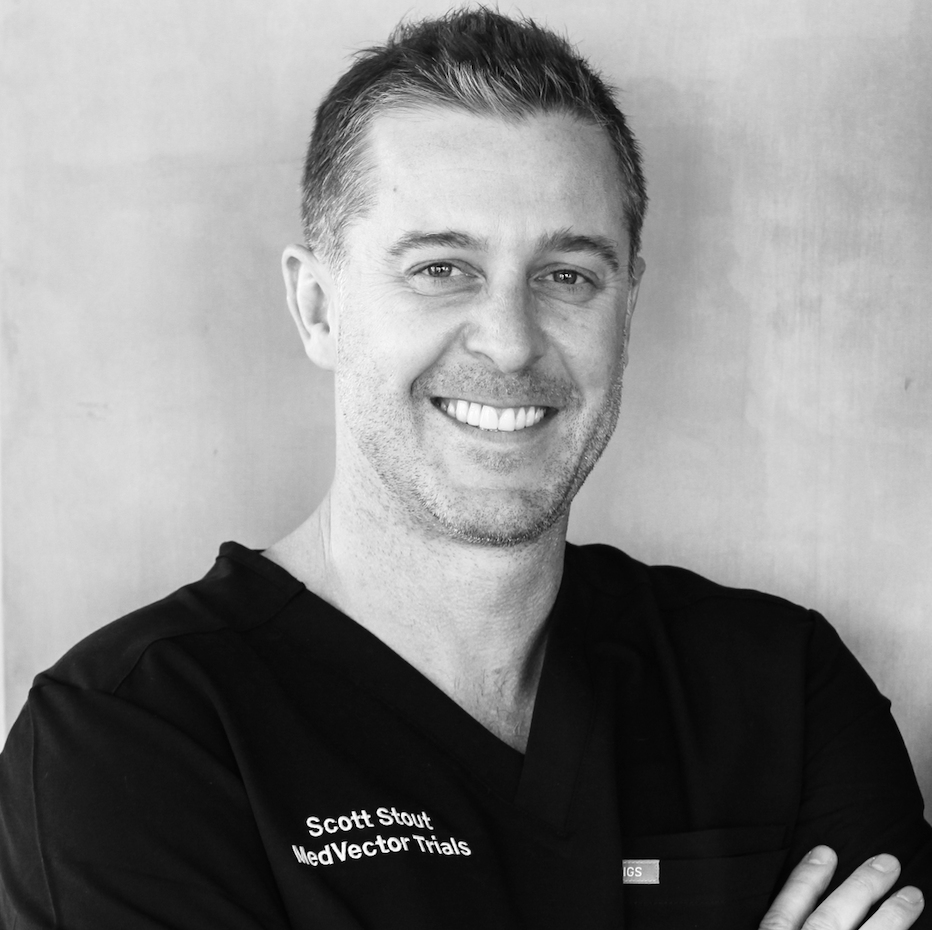
Scott Stout, CEO & Co-Founder at MedVector Clinical Trials
This episode features Scott Stout, who is helping reshape clinical trial recruitment through MedVector’s innovative HCP Recruitment model. By engaging community physicians in a new way, MedVector enables access to larger and more diverse patient populations for clinical trial sites.
Their approach allows trusted healthcare providers and their patients to benefit from clinical trials as a care option—without requiring physicians to become investigators or risking patient leakage. By aligning provider incentives, MedVector opens access to millions of patients who are traditionally excluded from clinical research.
In this episode, we discuss the challenges of patient recruitment, the importance of diversity in clinical trials, and how MedVector is redefining provider participation in clinical research.


Jesus Moreno (00:01.908)
Welcome back to Global Trial Accelerators, the podcast where we dissect the barriers to clinical innovation and explore the strategies driving the next generation of life-saving therapies. I am your host, Jesus Moreno, and today we're going to look at the convergence of high finance initiative alignment and sorry, I'm going to do that again.
I am your host, Jesus Moreno, and today we're looking at the convergence of high finance initiative alignment and the decentralization of clinical research. In this industry, we often talk about patient centricity, but we rarely discuss the business realities of doctors who actually hold the relationship with those patients. Why would a local physician refer a patient out if that means loss revenue?
My guest today is Scott Scout from MedVector. Scott brings a unique financial lens to this problem. Formerly an investor and option strategist with Morgan Stanley and Wells Fargo, he is now applying the economic disciplines to the healthcare.
Jesus Moreno (01:23.134)
Formerly an investor and an option strategist with Morgan Stanley and Wells Fargo, he is now applying the economic discipline to healthcare, building a model that moves trials beyond clinical sites to unlock the millions of patients currently sitting in local doctor offices. Scott, welcome to the show. It's a pleasure to have you with us.
Scott Stout (MedVector CEO) (01:45.902)
It's good to be here. Thanks for having me.
Jesus Moreno (01:49.0)
Scott, I would like to start with your origin story because it's distinct. You didn't come up through labs or a CRO world. You came from high finance, managing ultra high net worth portfolios. Often industry insiders are too close to the problem to see the obvious solution. So how has your background in finance and valuation helped you diagnose the inefficiencies in clinical trials?
Scott Stout (MedVector CEO) (02:19.416)
Well, so basically you stole my answer in the question. And, you know, people ask me a lot, you know, how did you come up with MedVector as somebody that wasn't part of the industry, that didn't work in healthcare? And, you know, they say, how were you able to think so far outside the box? And my answer was simple. was, I was never in the box. So it was easy for me to think outside the box. And I think sometimes that's necessary for
industries that get kind of a little bit stuck is to just have a little bit of outside perspective. And that's what happened. And so, you know, as we'll talk today, I'll tell you the solutions that we're doing. And a lot of them are going to feel like no brainers. They're going to feel like, what? Why wasn't anybody doing that? You and you spoke about patient centricity, right? And there's a big thing. And so right now, pharma is talking about
How do we become more patient-centric? they talk about study design and how can we make it easier for the patient to participate? How can we make the forms easier for patients to fill out? When they've passed over the most important and obvious part of patient centricity, it's that patients don't want to be their own advocates. When they don't feel well, they want to turn to their doctor and they want their doctor to assess, diagnose, and prescribe something that makes them feel better.
They don't necessarily want to understand how the medicine works or how the molecule works. And that's what the industry has done is we think that we need to give patients more information. But what we really need to do is we need to give patients the tools that they need to make the decisions that they don't want to, which is their doctor. So by including their doctor, they're able to make those decisions and feel more comfortable participating. So that's just a little sidebar.
But she asked me how I got into it from finance. Did you want me to tell that story from? OK.
Jesus Moreno (04:17.394)
Yes, please. Please, yeah. I think the audience would be interested.
Scott Stout (MedVector CEO) (04:21.664)
Sure. So I was an option strategist for Morgan Stanley. And then I was recruited over to Wells Fargo Private Bank as part of an ultra high net worth wealth management team. And the way that we conducted our business. Well, typically when you're dealing with this level of wealth, you're typically not dealing with employees. It's usually business owners. And so the way that we ran our book of business is we were a bunch of analysts that
act as free strategist for our clients. So we got to know our clients' businesses really, really well. And then we would make recommendations. And so we're free consultants. So it was a huge value add for our clients. And we would make introductions. And we even set a couple of people up on dates to a couple of different clients. So we were just kind of that value add. And
In one of these meetings, I was introducing two of our clients. One of them was a private equity company that buys hospitals. And the other was a data analytics company that does hospital turnarounds. And so this was a no brainer to put these two CEOs in a room together to where it was a safe space to where they could kind of bitch a little bit and also, you know, collaborate to see how they could make each other better.
And so it was just kind of a brainstorming session on how we could find more revenue streams for those private equity hospitals. And we randomly started talking about clinical trials. And I said, why aren't you doing the clinical trials in your hospitals? And the private equity guy said, well, we would, but we don't know how. We don't have the relationships with pharma. We don't know what doctors we would need. We don't know what protocol design is. We just don't have any experience doing it. And as a private equity company, we model everything.
And if we can't model it, we don't do it. And that's when I asked a really dumb question that ended up changing my life. So the question was, I said, well, why don't you refer your patients to the other hospitals that are doing clinical research and collect the referral fee? And he looked at me and he said, because I don't want my customers walking into another hospital. And this was Cardinal Sin. Remember I was the analyst in the room.
Jesus Moreno (06:32.062)
Mm-hmm.
Scott Stout (MedVector CEO) (06:42.262)
And I had forgotten that patients were customers in this model. And so just backpedaling as quickly as I could, said, well, what if we found a turnkey clinical trial company that lands their people in your hospitals, does some sort of profit sharing, and then when the study is over, they up and leave? He said, go find me that. So we went looking for that. And it turned out that that didn't exist, right? So kind of a no-brainer model that just didn't exist. And then we took it a step further. Now, this was
before COVID. And we took it a step further and we said, well, why would we need to land boots on the ground at all? Why couldn't we use this new thing called telemedicine? And this is before anybody knew what telemedicine was, right? And so we scheduled another meeting with a CEO of one of the major telemedicine providers. And we said, we'd like an introduction to who you're using for clinical trials because we'd like to implement it into our hospital system.
And he got quiet and he said, we don't have one. He said, we've been looking for two years and nobody's doing it. This is a no brainer and nobody's doing. So quite literally, I'm a financial analyst in a room with two of my clients, helping them connect a dot. And I raised my hand and I said, all right, guys, if I do it, do I have the support of everybody in the room? They looked at me like, what if you do it?
was like, yeah, guys, maybe you don't understand what we just identified. We identified a digital marketplace that is solvable using existing technology.
That's the same as Uber, right? That's the same as Amazon. So this has the potential to be very, very big. And when I say, yes, I'll do it, if I have the right partners here, yeah, I'll do it 100%. I will do it. These guys, I know I had made money for these guys, right? I was their banker. And they were like, all right, if you're that serious about it, let's do it. So we went around the table.
Scott Stout (MedVector CEO) (08:50.344)
And I got a lead investor out of the private equity company. got a two-year exclusive on the spot from the telemedicine provider. And I got a co-founder out of the data analytics company. And that was when the idea of MedVector was born.
Jesus Moreno (09:05.509)
Wow, that's an incredible story. And that's a fantastic insight. The idea that the gatekeeper was actually incentivized to keep the gate shut. So transitioning from finance to a highly regulated space like healthcare, it's not an easy task. I'm curious. Yeah.
Scott Stout (MedVector CEO) (09:15.725)
Right.
Scott Stout (MedVector CEO) (09:26.348)
Well, know, interestingly enough, they're both highly regulated. So I run into kind of the same demons in both spaces, right? Where, where people talk about regulation like they're a lawyer. People talk about regulation. you can't do that from somebody who's actually never read the law or never read the guidance. And so there's, there's this, what I call compliance funnel.
Jesus Moreno (09:31.838)
Right.
Jesus Moreno (09:51.124)
Mm-hmm.
Scott Stout (MedVector CEO) (09:55.298)
that exists in both of them. And that's where the FDA or the SEC or a regulatory body will draw the lines in the sand right here. And they'll say, if you go outside of here, we're scratching the whole thing. So don't go outside here. And so then the pharmaceutical company goes, we can't walk the line. So we're going to make the line here. And then they tell the CRO, this is where the line is. We talked to the FDA. This is where the line is.
And then to the CRO does the same thing. So we can't violate that. We're going to put the line here. And then the CRO talks to the study team and says, the study team, this is, you know, here. And then by the time you get down to the actual users that are involved, the lines are like here, even though legally they're here. And so you hear all of these people saying, oh, well, you can't do that. And that's a great example of this is the concept that of drug storage. Okay. So.
So some clinical trial sites will use biometric fingerprint locks to protect the drug cap. Well, and if you ask them, why do you have the biometric lock? They're like, oh, the FDA requires it. No, they're not. The FDA says it has to be under lock and key. And that's better. Like a biometric thumbprint is better, right? But...
But the law says it has to be under lock and key. And so if you were to ask the compliance person at that clinical trial site, they would say, well, this is the law. And so you see that same style of compliance funnel in financial regulation as you do healthcare regulation. it wasn't a... There was a learning curve, right? I say that I was drinking from the fire hose for half a decade.
I understood how to navigate it because I had already done it for so long.
Jesus Moreno (11:56.775)
into our audience that is listening to this podcast. Scott went from keeping her, excuse me, keeping his hands about a foot apart to keeping them like an inch apart when describing how the line is being drawn closer and closer and more narrow in terms of regulation. So, it's an interesting analogy or analysis of how
being over cautious costs potential opportunities.
Scott Stout (MedVector CEO) (12:32.738)
Yeah. And in fact, the pharmaceutical industry itself is an industry that must be rooted in innovation. Right. So it's not like a consumer goods company, right. Like Kellogg or something like that, or General Mills, where they can repackage and rebrand something and remarket something. The pharmaceutical industry doesn't work like that because everything is controlled by medical patents. So you have to have something in your pipeline.
Jesus Moreno (12:47.508)
Mm-hmm.
Scott Stout (MedVector CEO) (13:01.728)
You you can't just rebrand Viagra. You know, you have to have it because the generics come in and then that big money making window goes away. So it's a space that must be rooted in innovation. And right now I believe that it values caution over innovation. And that's just not sustainable. And the finance...
guy in me, when you see these types of things happen in an industry, you know when to shorten industry because you start seeing it stagnate and it not growing. Clinical trials are starting to take longer and longer. Innovation feels like it's being trapped behind the throughput rather than development. And these are all kind of red flags for an industry that eventually you'll start to see.
consolidation and layoffs. And sure enough, that's what we've been seeing for the last three years is a lot of consolidation and layoffs. So this industry is ready for a change. And we're getting rid of a lot of them, the pharmodinos sitting behind me. But again, this is an industry that must be rooted in innovation.
Jesus Moreno (14:15.22)
You
Jesus Moreno (14:21.616)
Excellent. Thank you for sharing that, Scott. And I would like to take a step back, zoom out to the more macro landscape for a minute. We're seeing a lot of conversations right now about where the next wave of patients will come from. As you know, big academic research centers are overwhelmed and often tapped into the same patient pools.
From your perspective, have we hit a point of diminishing return with regard to that traditional site model? And a follow up on that, is the industry reaching a saturation point where we simply can't squeeze more patients out of the same few institutions?
Scott Stout (MedVector CEO) (15:08.696)
Well, so yes and no to both of those. There's a catch-22 that exists between the FDA and HIPAA. So, and most people have heard of HIPAA, but HIPAA is the healthcare privacy laws. So, HIPAA says you can't buy or share healthcare data. The FDA says you can't market a new medicine until you prove its efficacy in patient safety.
So you have to do statistical analysis to prove that it does what you say it does. So that means that you have to do a clinical study and you have to find patients that have the ailment that you're trying to cure and you have to show that it's at least getting better. But then HIPAA says you can't buy a list of patients that have that ailment. So if you can't market it and you can't buy a list, how do you find patients?
So this has been a huge dilemma in this industry forever, to the point where it's created a multi-billion dollar industry called patient recruitment. And the majority of today's patient recruitment exists between billboards and Facebook ads. So, Asus, I love asking everybody this. When was the last time you dialed a phone number off a billboard?
Jesus Moreno (16:31.292)
I can't say I have in the past four years or more.
Scott Stout (MedVector CEO) (16:35.148)
Right, you and everybody else. So are the clinical trial pools, the places that we're finding patients, are they getting saturated? Yes. But the methods that we're using to identify these patients is about this big, right? patient, go ahead.
Jesus Moreno (16:54.193)
And again, for the audience that's listening to this, Scott is holding his fingers about half an inch apart.
Scott Stout (MedVector CEO) (17:01.41)
Yeah, it's tiny, right? So the solution is we know that the patients exist because the pharmaceutical industry wouldn't be manufacturing a drug for no patients, right? That's just business 101. So we know that those patients exist. So why is it so hard to get to them? The reason it's hard to get to them is because of that HIPAA Catch-22. So right now the industry says, all right, well, let's make every doctor a principal investigator for clinical studies.
Well, doctors don't want to be investigators. So that doesn't work either. In fact, most doctors that try clinical research, it's one and done. It's like 90 % it's one and done. They're like, this was a huge headache and I didn't have the volume that I thought that I would. And so, no, I'm not interested in doing this again. So now you've got dedicated clinical trial sites who have multiple studies and do this for profit. And they try to partner with local physicians to find these patient populations or hire
patient recruitment companies to create Facebook ads that say, you know, do you have this click this link and then enter all of your healthcare data, which works because it has to, because there's no real alternative. But the missing link that MedVector creates is engaging with these local treating physicians that have the patients. So if we think about it, we know exactly where the patients are, right? So if I'm working on a cardiology study,
He says, what doctor should I go talk to?
Jesus Moreno (18:33.426)
cardiologists, I would say.
Scott Stout (MedVector CEO) (18:34.56)
a cardiologist, boom, right? So we already know this and nobody's been doing that because there hasn't been a way to collaborate with these treating physicians without making them an investigator. And so that's what MedVector is doing is we're saying, we're using new decentralized tools like telemedicine and we're saying, does the patient need to be at the clinical trial site for every appointment or should maybe the easier visits
happen at the provider's office. So the provider feels engaged and included. The provider doesn't feel like they're losing a patient. And also now we can compensate the provider for the effort and work that they've done. So this is really the huge win and it is hugely unlocking floodgates of new patient populations. So to give you an example, we were working on a study
and it was actually a cardiology study and we went and found cardiologists. So the goal of the site that we were working with was to enroll five patients. Okay, this gives you an idea of how broken the industry is. The study itself needed 1,300. The site's goal was five, just five, not 500, five. And they were struggling to find five. We partnered with them. We identified 11 local cardiologists.
and using full inclusion exclusion criteria for that study, we identified 163.
Jesus Moreno (20:08.605)
a market difference.
Scott Stout (MedVector CEO) (20:10.378)
a huge and exponential difference, right? And so do the patients exist? Yes, to answer your question. Is there a lack of bandwidth in the current way that we're identifying patients? Yes. And there is cannibalization that's happening because, you know, there's a new drug will be discovered or a new technology. And then you'll have four pharmaceutical companies all going through clinical trials at the same time, trying to get that first to market.
Right? Well, that means that sect is now bifurcated into four. So you're absolutely right. So it doesn't work under the current model, which is why we're seeing so much holdup.
It's going to take companies like MedVector that are engaging these local physicians to really move the needle. And it's going to be necessary because I believe that there's a wave of innovation headed our way that potentially could rival the industrial revolution. I'm not even kidding. When we talk about gene editing and gene sequencing, when we talk about stem cell research, we talked about
Jesus Moreno (21:13.555)
Wow.
Scott Stout (MedVector CEO) (21:22.846)
AI and quantum computing and quantum computing where we can analyze a strand of DNA now, right? And then edit the genes to manipulate it. So, and then with AI piecing all of these new things together, we really are just at the tip of the iceberg as far as a healthcare revolution.
Jesus Moreno (21:47.839)
That's exciting. That's very exciting. It seems that the brilliance is in the initiative of aligning the local doctors incentives so that they can be heroes and keep the revenue by keeping the patient in their practice. But there's a key element that I'm curious to learn about.
Scott Stout (MedVector CEO) (22:08.706)
Yep, that's the rid.
Jesus Moreno (22:16.318)
that I think it's missing from that equation and that element is trust. How do you handle trust factor? When patients are having to interact with a remote PI, principal investigator, who has patients, who sees patients physically less often than their counterpart.
Scott Stout (MedVector CEO) (22:43.694)
Well, so, and that's a great question. And the trust that's necessary for a clinical study doesn't necessarily fall with the investigator because the investigator is a new doctor to this person, right? If the drug works, well, then guess what? They're gonna trust that person. But if it doesn't work or let's say they have the placebo, right, in a dual arm study, it's not that they won't trust them, but they just...
that trust never grew. So by collaborating with that patient's doctor, the trust exists there. So by allowing that patient to participate in some of those visits from a practice that they are familiar with and a doctor that they do trust, our conversion rates go way up, right? So patients are much more likely to participate in a study
when it's their doctor that calls them than if it's some random person that calls them. There also, I don't know if you've ever been sick to the point where you've had to go to a specialist and you've got a relationship with a specialist, but those relationships go deep to where if you're participating in a clinical study that was recommended by your specialist, you're not likely gonna drop out of it.
and you're especially not gonna just no show to appointments, you're gonna have the conversation with your doctor. Be like, I don't feel like it's doing anything, you know, should I drop out? Now, while the doctor can't influence you one way or the other due to good clinical practice, they still are a very important sounding board for that patient in making that decision.
Jesus Moreno (24:25.929)
Hellbukit
Jesus Moreno (24:33.503)
That's, I think that's a key element to keeping, that trust in the relationship as part of the strategy to, you know, reduce the, the number of patients that drop out of a study. And that brings us to the, concept of access. Having overcome that trust issue that, that in my mind, that the logical next step is the concept of access and to solve the enrollment gap.
the industry usually defaults to expanding the geographical reach for the study. And that in and of itself increases the complexity significantly dealing with fragmented regulatory bodies and supply chain challenges. the leveraging telemedicine seems like a good opportunity to tackle that expansion from a different angle.
So how do you see expanding to other geographies? How does that fit into what medvector is doing? Is that a logical next step?
Scott Stout (MedVector CEO) (25:46.67)
Well, so clinical trials in general require a certain amount of geographic diversity. So a major novel drug study, you couldn't just do at a single clinical trial site. You would have to have that geographic diversity. So that component is already necessary in the clinical trials arena.
The interesting part about utilizing telemedicine, especially in a fully decentralized study, meaning that no visits are done at the clinical trial site. They're all done outside of the clinical trial site. So in a fully decentralized environment, you can fulfill that geographic diversity from much fewer clinical trial sites. And so that is the part that really gets interesting. instead of like in that...
that cardiology study that I gave as an example that needed 1300 participants and the site goal was five. So you can imagine how many sites they're gonna need to get through that study, right? Or maybe next year that same site will enroll another five, right? But it's just, it's too slow and it's expensive turning on all of these clinical trial sites. So it's much, much better.
to drive more participants to less sites than it is to drive the same amount of participants to more sites. so telemedicine is a big component of eliminating that geographic constraint that exists in the current model.
Jesus Moreno (27:30.971)
And is that scalable to other geographies or countries to be more clear?
Scott Stout (MedVector CEO) (27:36.762)
yeah. Yeah. Big time. So there's different regulatory bodies and you have to play nicely with the different varying governments because everybody has their own patient safety rules. But where clinical trials is heading, so here's my vision, is right now clinical trials pop up where the patients are. And a lot of times that's expensive, right? So you're in New York, you're in Los Angeles, you're in Chicago.
And so these are major hubs that have expensive real estate. In a fully decentralized market or study or environment, you don't have to have the sites where the patients are. So instead, these clinical trial sites can act as call centers, right? And it's where you've got coordinators on telemedicine devices with a principal investigator.
in the room walking behind them and you could have 750 computers in the room, all doing patient visits. And because you've eliminated the geographic constraint, you can have that call center in Kansas, some place where real estate is inexpensive and you can also have it open 24 hours a day. And then you can follow the globe, right? So there's...
a HIPAA compliant and FDA compliant telemedicine with language translation that now exists to where you could start your day in New York, then Chicago, then Los Angeles, then Japan, then China, then Germany, then the UK, and then back to the New York. And the call center could be open 24 hours a day.
Jesus Moreno (29:34.825)
Wow, that's incredible access actually. That solves many, of the challenges the industry faces right now.
Scott Stout (MedVector CEO) (29:42.786)
Yeah, the populations, they exist and it's just a matter of reaching them. so right now, a lot of people don't know this, but the average time for a new drug to get to market is between 10 and 14 years. Years, right? So that's like more than a decade for a medical breakthrough to get to somebody that needs it. That's terrible. So it's terrible because people are dying, right?
while waiting for drugs, waiting for it to be approved. Drugs that we know work, right? We're waiting for them to be approved because we can't find the patient population to test it and prove it. So the fact that people are dying or suffering while waiting is terrible. But the other terrible component is the profitability of that drug. Because if you remember from earlier, the length of a medical patent is only 20 years.
Right? So if you take 10 to 14 years getting to market, that leaves you six to 10 years to recoup potentially what? $2 billion of costs from manufacturing to development, to clinical trials, to sales and marketing. Right? And so now you've got this small window to recoup all of these while you're still protected for that patent.
Jesus Moreno (31:00.615)
marketing
Scott Stout (MedVector CEO) (31:11.278)
So why do you think drug prices are going up? Because we're at a stalemate. It's taking longer longer and longer and longer to get through these clinical trials. And so to give you an example, we did an analysis. This blows everybody's mind. We did an analysis for Humira. So Humira was the number one selling drug in the world two years ago. And that's when the patent expired. So AbbVie's patent for Humira expired two years ago.
we did the analysis and we looked at how much did AvuSell two years ago and then how much did they sell one year ago. So they still sold a lot last year, okay? They still sold billions worth. But the difference between when they had the patent versus when they lost the patent, that difference averaged over a 12 month period came down to $33.5 million.
a day.
$33.5 million a day is how much that patent was worth. So when you start to ask a company like AbbVie, would you pay a billion dollars for another year of patent protection? Yep.
So would you pay a billion dollars to get through clinical trials more quickly? Yep. Does it cost a billion dollars to do med vector? Nope. And so herein lies the problem, right? It's getting people out of the way, getting people out of their own way.
Jesus Moreno (32:37.045)
You
Jesus Moreno (32:44.935)
Of course. And with that Scott, for the sponsors and CROs listening who are struggling to hit those enrollment targets, what is the low hanging fruit for them? What type of therapeutic areas or trial designs are best suited for med vector? If there's any specific ones.
Scott Stout (MedVector CEO) (33:06.648)
Well, so there's a spectrum of how decentralized a study is. And you've got that spectrum from fully decentralized to not at all decentralized. The studies that are not at all decentralized, MedVector can still help because we can still collaborate with those local providers. do what we call HCP recruitment, which is healthcare provider. So healthcare provider recruitment around your clinical trial sites.
to create relationships with those physicians surrounding your doctors. And this hugely increases the referral rates. Now, as you start to move through that spectrum of decentralization to med vector hybrid, which is some of the visits happen at the doctor's office, some of the visits happen at the clinical trial site, well, those physicians become more motivated to participate, right? Because now it's not just a referral.
It's they're participating. And then as we get to fully decentralized, well, that's when we can start to partner with major data systems like LabCorp or CVS, right? So CVS has what they call Minute Clinics. So CVS is a pharmacy that's, that, you know, is a national pharmacy. And these Minute Clinics isn't not every CVS, but I don't know, maybe one out of 10 has a Minute Clinic.
but these med clinics potentially could be access points for patients to access clinical trials.
And so in a fully decentralized world, CVS has probably 200 million patient records. That could fill a clinical study pretty quickly. So again, as we get closer and closer to full decentralization, the easier it gets to find patients quickly for your clinical study. And you said something earlier that I wanted to touch on about patient access, right?
Scott Stout (MedVector CEO) (35:13.154)
And so patient access, people forget that's a two-way street. So we've got access for patients, which is important, right? How do we help those in need? Access for patients. And then we also have access to patients, which is how do studies find the patients that they need to get FDA approval to help the people that need it, right? So patient access is a two-way street and MedVector very much solves
both directions.
Jesus Moreno (35:45.918)
Wonderful. Scott, your journey from the finance world into the heart of patient access offers a blueprint for how better business incentives can lead to better healthcare outcomes. Thank you for sharing your insights with us today and for participating in our podcast.
Scott Stout (MedVector CEO) (36:06.542)
You're welcome, this is fun.
Jesus Moreno (36:09.445)
And for listeners, if you're looking to understand how to leverage local physicians to expand access to patients, I highly suggest you take a look at what Scott and the team at MedVector are building. Until next time, keep accelerating.
CEO
Scott Stout is the CEO of MedVector, a clinical trial company focused on engaging and collaborating with non-investigator physicians to accelerate enrollment and enhance patient access. Scott was named one of the "Top Healthcare CEO’s to watch in 2021" and was inducted into Marquis "Who's Who in America" in 2024-2025.